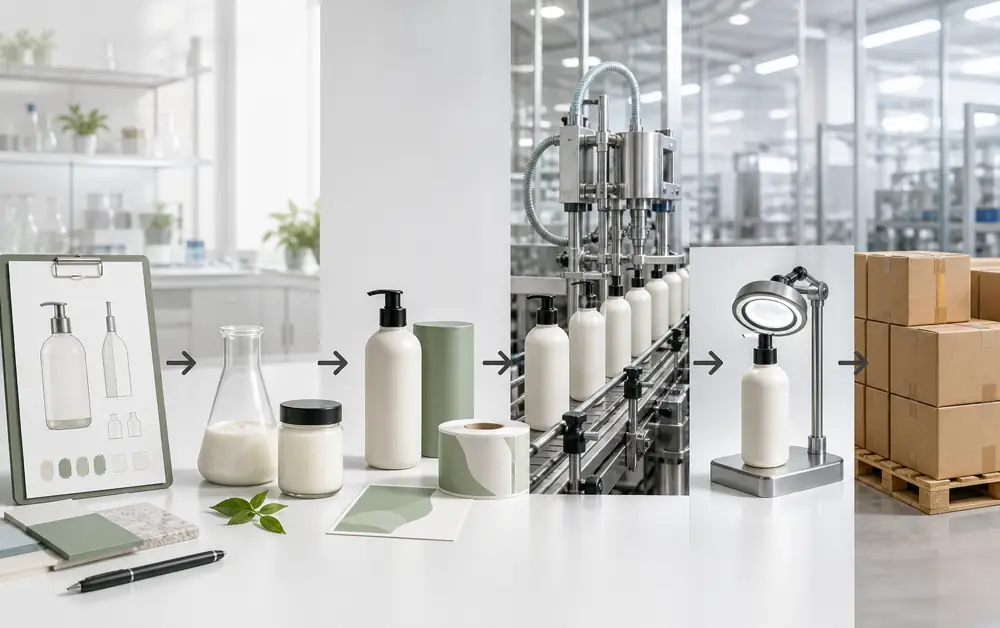
Choosing a hair conditioner OEM manufacturer is not mainly about finding the lowest unit price. The right partner must be able to make the agreed formula, fill it into the right packaging, control quality, and support the documents and schedule needed for your target market. Start by comparing factories against the same written brief. Then verify their formula route, quality process, MOQ, packaging capability, compliance scope, and change-control process before you approve samples or pay a deposit.

Short answer: Choose a hair conditioner OEM manufacturer that can explain, in writing, how your product will move from brief to sample, bulk production, inspection, and shipment. A good quotation is specific about what is included, what the buyer must approve, and which event starts the production lead time.
Why choosing the right hair conditioner OEM manufacturer matters
A conditioner can look simple on a shelf. In production, it is a connected project. Formula texture affects the pump or closure. Packaging affects filling and transport. Claims affect label review. The destination market can change the documents and checks that the brand needs.
That is why a polished website or a large product catalogue is not enough. A hair conditioner OEM manufacturer should be able to turn your product brief into controlled specifications, samples, approvals, and an agreed production plan.
For a wider view of the available project routes, see our guide to conditioner OEM vs. ODM vs. private label. If you are still defining the product, start with the SEVICH OEM/ODM services overview.
How to choose a hair conditioner OEM manufacturer: compare the six essentials
Use the same questions for every supplier. It makes quotations easier to compare and exposes missing information early.
| What to compare | What a capable conditioner OEM supplier should show | Warning sign |
|---|---|---|
| Formula route | Whether the project uses a mature formula, an adjusted base, a matched sample, or a new formula | “We can make anything” without asking about hair type, texture, claims, pack, or market |
| Product and packaging fit | How viscosity, dispensing, fill size, bottle, closure, label, and carton will be checked together | A bottle is selected before the product texture and dispensing method are discussed |
| Quality controls | Documented incoming-packaging, in-process, and finished-goods checks | Only a general promise of “100% quality” with no defined checks or acceptance criteria |
| Commercial scope | MOQ by SKU and component, sample rounds, tooling or packaging costs, payment terms, and the event that starts the lead time | One broad price that leaves formula, print, testing, or freight unclear |
| Market readiness | What manufacturing records the factory can provide and which legal duties remain with the brand or market partner | Calling every document a “certificate” or promising market approval without reviewing the product |
| Change control | How formula, artwork, component, quantity, and market changes are reviewed after approval | Instructions are accepted only in chat messages, with no revised specification or timeline |
The best factory is not automatically the one with the longest list of options. It is the one that clearly identifies the options that fit your launch.
1. Check the conditioner formulation route before you request a final quote
Ask a potential custom conditioner manufacturer what will be used as the starting point. The answer sets the work, cost, sample plan, and ownership discussion.
| Starting route | Usually suitable for | Buyer questions to ask |
|---|---|---|
| Mature formula / private label | A faster launch or a market test | What can change? Who else can buy the base formula? What is the MOQ for each fragrance and pack? |
| Adjusted base formula | A brand that needs a different fragrance, sensory feel, color, ingredient direction, or performance target | Which changes need development work or a new MOQ? How many sample rounds are included? |
| Reference-sample matching | A brand with a physical benchmark | Which features can be matched, and which may change because of materials, process, IP, or market rules? |
| Buyer-supplied formula / OEM transfer | A technical brand that owns a formula or specification | Can the factory source equivalent materials, scale the process, and document any approved changes? |
Do not accept a sample because it is “close enough” without recording what was approved. A useful sample approval references the formula or batch code, fragrance, color, texture, fill size, packaging, and the observations that matter to the buyer.
If the product is for dry, curly, fine, or color-treated hair, make the target user part of the brief. Our guide to choosing a custom conditioner formulation by hair type shows the questions that help turn a broad idea into a workable development target.
2. Ask how the conditioner factory controls quality at each stage
“Quality control” should describe real checkpoints, not a slogan. For a private label conditioner project, ask what is inspected before production, during filling, and after the finished goods are packed.
A practical discussion covers:
- incoming bottles, pumps, labels, cartons, and other packaging components;
- bulk product appearance and the agreed product criteria;
- fill, closure, coding, label placement, and carton packing on the line;
- finished-goods inspection and the buyer’s agreed acceptance process;
- what photos, records, samples, or third-party inspection arrangements can be agreed for the order.
The inspection plan should fit the product. A thick hair mask in a jar and a light leave-in conditioner in a spray pack do not have the same filling or compatibility risks. Ask the factory how the selected formula dispenses from the selected package.
For manufacturing practice, ISO 22716 provides cosmetic GMP guidelines covering production, control, storage, and shipment. [Official external link: ISO] It is a manufacturing-practice standard, not product approval or proof that a product will deliver a marketing claim.
3. Compare MOQ, sample timing, and lead time in the same way
MOQ is not one number for every conditioner. The formula, fill size, bottle, closure, decoration, label, carton, and component supplier minimums can each affect it. Ask for an MOQ by SKU and identify whether fragrances, colors, or packaging variations have their own minimums.
At SEVICH, the normal planning MOQ for a conditioner project is 2,000 to 5,000 units per product, depending on the approved formula and packaging. This is an early planning range, not a binding offer. The written quotation for the approved specification is the final reference.
Also separate each phase of the schedule:
| Project phase | Question for the conditioner OEM manufacturer | Why it matters |
|---|---|---|
| Stock sample | How quickly can an existing sample be sent after the brief is clear? | Lets the buyer assess a mature formula before requesting changes |
| Custom sample | What information is needed before development starts, and how are revisions handled? | Avoids starting a sample round from an incomplete brief |
| Packaging preparation | Which components are stock items and which are made to order? | Custom colors, decoration, and special closures can add time |
| Bulk production | What approvals, deposit, and material conditions release the production slot? | Prevents the buyer from treating inquiry date as the production start date |
| Freight | Who books it, under which Incoterm, and what is excluded from the factory schedule? | Keeps factory lead time separate from transit, customs, and warehouse receiving |
SEVICH normally plans stock samples in 1 to 3 business days, new custom formula samples in about 7 business days, and bulk production in about 25 business days after the required approvals, deposit, and materials are ready. These are project-planning figures. Formula revisions, custom packaging, tests, freight, customs, and local delivery can add time.
For a fuller budget and schedule checklist, read private label conditioner MOQ, cost, and lead time and the custom conditioner development timeline.
4. Review packaging capability as carefully as formula capability
Many sourcing problems arrive after the formula sample is approved. The product may be too thick for a selected pump. A bottle may not match the chosen fill volume. Artwork may need changes because the ingredient list, claims, warnings, or market information is still moving.
When comparing a conditioner OEM supplier, ask for the packaging decision path:
- What fill sizes, containers, closures, and decoration options are feasible for this formula?
- Can the supplier provide dielines before artwork is final?
- Which artwork elements must be confirmed before printing starts?
- Can buyer-supplied bottles or packaging be inspected and filled? If so, who is responsible for shortages, damage, compatibility, and delays?
- Is a packaging compatibility review included, and what does it cover?
For routine conditioner lines, daily care conditioner product options can help a buyer discuss format and pack direction with a supplier. Do not assume that a product image confirms the availability, MOQ, or compliance status of a specific pack; confirm these in the project quotation.
5. Separate factory documents from market-access responsibilities
This is where many supplier comparisons become misleading. A factory may supply manufacturing records or support a product review, but the brand’s legal obligations do not disappear because another company makes the conditioner.
In the United States, the FDA explains that cosmetic products and ingredients, other than color additives, generally do not need FDA approval before sale. Companies remain responsible for safety and proper labeling; the FDA’s page also explains requirements introduced by the Modernization of Cosmetics Regulation Act of 2022 (MoCRA). Read Cosmetics & U.S. Law before final U.S. artwork is approved.
For the European Union, Regulation (EC) No 1223/2009 is the core framework for finished cosmetic products. The European Commission states that an EU-based responsible person is required, a product safety report is prepared before placing a product on the market, and notification is made through the Cosmetic Products Notification Portal (CPNP). [Official external link: European Commission] See the European Commission’s cosmetics legislation page.
Use this question set with every supplier:
| Ask for | Clarify in writing |
|---|---|
| Product and manufacturing records | Exactly which documents can be provided for the approved product and pack, and at what stage |
| Test scope | Which tests are included, who commissions them, and whether they use the final formula and package |
| Label support | Whether the factory provides practical manufacturing input only or a defined regulatory service |
| Responsible parties | Who is responsible for product claims, local notification, label approval, safety assessment, import, and market placement |
| Terminology | That ISO 22716, a COA, an SDS/MSDS, a PIF, a CPSR, CPNP notification, and FDA registration/listing have different purposes |
Do not describe an ordinary cosmetic as “FDA approved,” or call a product “EU approved” because it has been notified. Requirements depend on the formula, claims, packaging, country, and named legal parties. Get qualified regulatory advice for the final market decision.
6. Check communication, ownership, and change control before sampling starts
Factory capability is important, but project control is what protects a launch. Ask who owns the next action at every handoff: buyer, sales team, R&D, packaging supplier, quality team, or freight partner.
Before you send confidential formula information or a benchmark, ask whether the supplier can review and sign an NDA. The final manufacturing agreement should address formula ownership, use of customer-supplied information, approved substitutes, and how changes are recorded. This article is a sourcing guide, not legal advice; have qualified counsel review the agreement that applies to your business.
A supplier should also be comfortable recording changes. A new fragrance, revised ingredient rule, bottle change, updated artwork, different quantity, or new target market may affect the quotation, testing plan, materials, and schedule. The question is not whether changes can happen. It is whether the hair care contract manufacturer has a controlled way to assess and approve them.
A scorecard for choosing a private label conditioner manufacturer
Use a simple scorecard after the first serious supplier conversations. Score evidence, not promises.
| Area | Weight | Evidence to review |
|---|---|---|
| Formula fit and development route | 25% | Brief questions, sample plan, approved product specification |
| Quality and production control | 20% | Checkpoint descriptions, acceptance criteria, audit or inspection options |
| Packaging and artwork coordination | 15% | Component feasibility, dielines, compatibility discussion, print-approval process |
| Commercial clarity | 15% | Quote scope, MOQ by SKU/component, sample and production conditions, Incoterm |
| Market and documentation clarity | 15% | Defined document scope and accurate division of responsibilities |
| Communication and change control | 10% | Named project owner, response process, revision log, NDA/ownership discussion |
Set a minimum score for each critical area. A low price should not compensate for an unclear formula route, no quality plan, or unanswered market-responsibility questions.
How SEVICH handles a conditioner OEM project
SEVICH can start from a mature formula, an adjustment to a SEVICH formula, a buyer’s reference sample, or a buyer-provided written formula. After the formula route is clear, the project team confirms the fill size, container material, appearance, label, carton, and design direction before preparing samples.
When the buyer approves the formula, packaging, artwork, and commercial scope, the project moves to the production stage under the quotation. SEVICH’s stated custom-project flow includes three quality checkpoints: incoming packaging inspection, production-line inspection, and finished-goods inspection. Production photos, buyer-supplied packaging, fill-only work, semi-finished product supply, white-background product photography, and formula confidentiality can be discussed and documented for the specific project; they are not automatic inclusions.
SEVICH states that it has more than 10 years of hair-care production and sales experience, a 10,000 m² facility, more than 300 production employees, and 20 production lines. These company facts should be reconfirmed by the responsible team before publication. Capacity figures do not replace a review of your formula, pack, target market, quantity, quality plan, and delivery date.
Request a hair conditioner OEM suitability review
Send SEVICH your product format, target hair type, formula direction or benchmark, required and excluded ingredients, fragrance and texture target, fill size, packaging idea, sales country, quantity per SKU, and required warehouse date.
The team can review the suitable development route, planning MOQ, sample path, packaging steps, quality checkpoints, and bulk-production conditions. If you are a distributor, wholesaler, salon group, or retailer, you can also request a discussion of SEVICH’s agency policy for your market.
Frequently asked questions
What should I ask a hair conditioner OEM manufacturer before requesting samples?
Ask which formula route fits your product, what information is needed for a workable brief, how many sample rounds are included, what packaging is feasible, what MOQ applies to each SKU, and what conditions start the production lead time. Also ask what quality checks, documents, and buyer approvals apply to the finished order.
How do I verify a private label conditioner manufacturer?
Start with a detailed written brief and assess the supplier’s answers against it. Review how it explains formula development, packaging compatibility, quality checkpoints, commercial scope, documents, and changes after approval. If your process requires it, arrange a factory audit or independent inspection under a defined scope.
What is a normal MOQ for private label conditioner?
There is no universal MOQ. It depends on the formula, fill size, packaging components, decoration, and each supplier’s material minimums. SEVICH uses a planning range of 2,000 to 5,000 units per product for conditioner projects, but the approved quotation sets the final MOQ.
Can I supply my own conditioner formula to an OEM factory?
Usually, a factory can review a buyer-provided formula or technical specification. It may still need a feasibility review, raw-material sourcing discussion, scale-up work, packaging compatibility checks, and written agreement on ownership and approved changes. Do not assume that a lab formula can move directly to commercial production unchanged.
Does an ISO 22716 factory mean my conditioner is approved for every market?
No. ISO 22716 concerns cosmetic good manufacturing practices. It does not by itself approve a formula, label, claim, or product for sale in a given country. Market requirements still depend on the product, packaging, claims, and legal parties involved.
Who is responsible for cosmetic compliance: the brand or the manufacturer?
The answer depends on the sales market and the agreed roles. A manufacturer may provide product or manufacturing documents and practical label input, but the brand, importer, responsible person, or distributor may carry separate legal duties. Put responsibilities in writing and obtain qualified local advice before market launch.
How long does a custom conditioner OEM project take?
The schedule depends on the formula route, sample revisions, packaging, artwork, tests, order quantity, and freight. At SEVICH, a new custom formula sample is normally planned at about 7 business days and bulk production at about 25 business days after approvals, deposit, and material readiness. The written project schedule is the final reference.