Table of Contents
- Conditioner OEM vs ODM vs private label at a glance
- What is private label conditioner?
- What is conditioner ODM?
- What is hair conditioner OEM?
- Why the terms overlap in real supplier quotations
- Which manufacturing model should your brand choose?
- How the model affects MOQ, cost, and lead time
- Compliance duties do not disappear when a factory makes the product
- Questions to ask a conditioner OEM, ODM, or private label manufacturer
- How SEVICH handles the three development routes
- Get a conditioner project route assessment
- Frequently asked questions
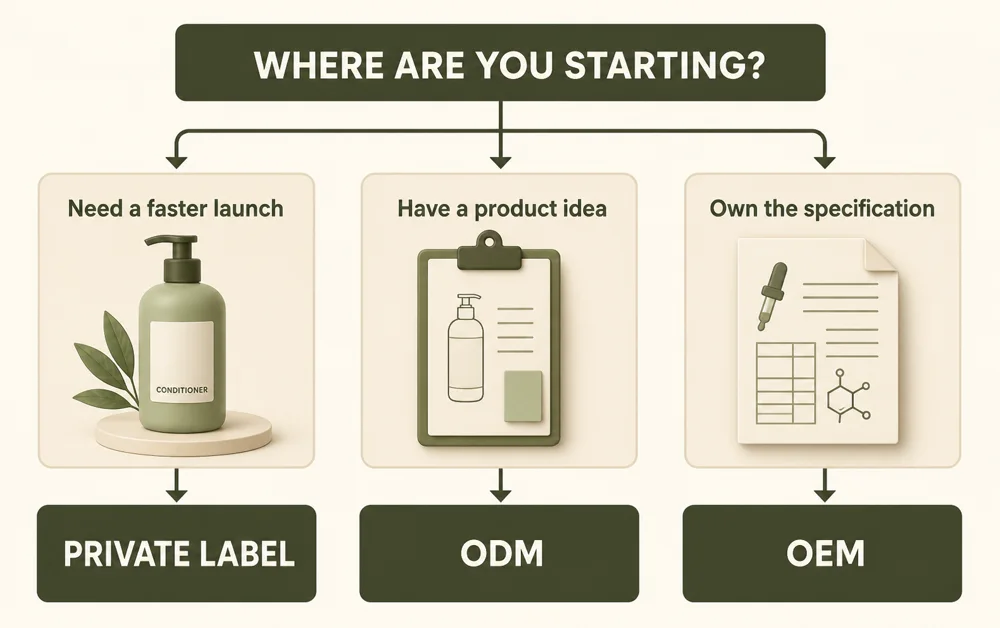
The practical difference between conditioner OEM, ODM, and private label is who brings the product specification to the table. A private label project normally begins with a manufacturer’s mature formula. In ODM, the manufacturer develops or adapts the product around the brand’s brief. OEM usually means that the customer already has a formula, specification, or reference for the factory to follow.
There is one complication: hair care suppliers do not use these terms consistently. One factory may call an adjusted stock formula “private label,” while another calls the same job ODM. The label tells you less than the written scope. Before comparing quotations, check the formula work, packaging, tests, documents, ownership terms, MOQ, and production steps included in each one.
Short answer: Private label suits a faster launch built on a mature formula. ODM suits a brand that has a product idea but needs development support. OEM suits a team that already controls the formula or product specification.
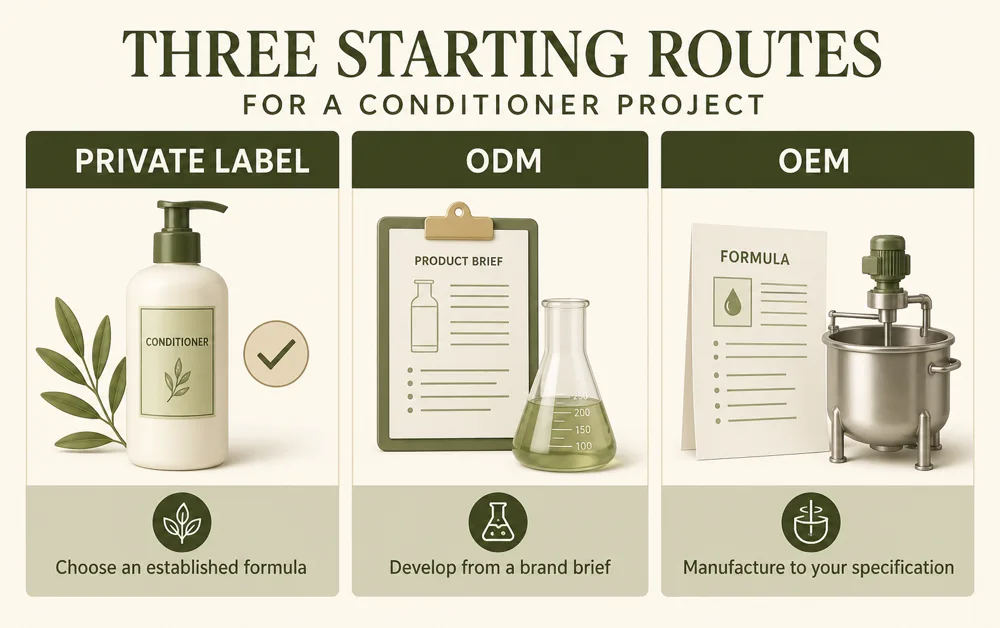
Conditioner OEM vs ODM vs private label at a glance
The table below uses practical working definitions. Always confirm how a specific conditioner manufacturer defines each service.
| Comparison point | Private label conditioner | Conditioner ODM | Hair conditioner OEM |
|---|---|---|---|
| Starting point | Manufacturer’s mature formula | Brand brief plus manufacturer development | Customer formula, specification, or reference product |
| Formula work | Low; selection or limited changes | Medium to high; adaptation or new development | Based on customer instructions and agreed feasibility work |
| Brand control | Branding, pack, fragrance, color, and available options | Product concept, performance target, ingredients, sensory profile, and pack | Customer controls the supplied specification, subject to safety, compliance, and production review |
| Manufacturer role | Provides an established product platform and makes the finished goods | Helps translate the brief into a manufacturable product | Produces against the approved customer specification |
| Sampling | Usually the simplest route | Often needs development and revision rounds | May need matching, pilot work, and production trials |
| Typical relative cost | Usually lowest | Usually medium to high | Depends on formula readiness, validation work, and materials |
| Typical relative lead time | Usually shortest | Longer because development comes first | Shorter if the specification is production ready; longer if transfer work is needed |
| Best fit | First launch, market test, salon line, or quick product extension | Brand with a clear consumer idea but no in-house formulation team | Brand with its own formula, technical team, or detailed benchmark |
| Main risk | A product that is not different enough | Too many changes without a firm target | Assuming a lab formula will move to factory scale without adjustment |
The contract, approved specification, and quotation matter more than the service name. They show what each side must supply and approve.
What is private label conditioner?
A private label conditioner starts with a formula that the manufacturer already knows how to make at commercial scale. The buyer selects the formula, fill size, container, label, and carton. Some manufacturers also allow changes to fragrance, color, texture, or selected ingredients.
Because the base formula is already established, the brand avoids much of the early formulation work. That can make sense for a first launch, especially when the team wants to test demand before paying for deeper product development.
The finished product does not have to look generic. A standard bottle can carry custom artwork, screen printing, a folding carton, and available surface finishes. Limited formula adjustments may also be possible. Whether the supplier still calls that private label or treats it as ODM should be stated in the quotation.
When private label is the sensible choice
Private label deserves a closer look when:
- the brand has a firm launch date;
- an established formula meets the product brief;
- the first order needs a simpler cost structure;
- the team wants to validate the market before paying for deeper development;
- packaging and brand presentation create enough distinction for the first launch.
The tradeoff is exclusivity. Other brands may be able to buy the same base formula. Find out which changes are available and whether the supplier will agree to any exclusivity in writing. Your label on a mature formula does not, by itself, give you ownership of that formula.
What is conditioner ODM?
In a conditioner ODM project, the brand brings the market idea and the manufacturer works out how to make it. A useful brief covers the target hair type, desired texture and fragrance, ingredient preferences, excluded ingredients, performance goals, price range, pack, and sales country.
Depending on that brief, the R&D team may adjust a stable base or develop a new formula. A request for a rich rinse-off conditioner for dry, curly hair, for example, still needs a defined sensory target and pack. The project then goes through feasibility review, samples, buyer feedback, approval, scale-up, and bulk production.
This model often fits a brand that understands its customer but does not have an in-house cosmetic chemist. Compared with a straightforward private label order, more of the development responsibility sits with the manufacturer.
What makes an ODM brief workable?
“Make a premium conditioner” is not enough. Premium can refer to texture, fragrance, ingredients, packaging, price, or all of them. A useful ODM brief answers practical questions:
- Who will use the product, and what hair concern does it address?
- Is it rinse-off conditioner, leave-in conditioner, hair mask, or a salon treatment?
- What should the product feel like during application and after rinsing?
- Which ingredients or claims are required, preferred, or excluded?
- What is the target fill size, packaging type, order quantity, and unit cost range?
- Where will the product be sold?
- When must the finished goods reach the warehouse?
Clear limits save sample rounds. They also reveal conflicts early. A demanding performance target, for instance, may not fit the proposed formula restrictions or cost ceiling.
What is hair conditioner OEM?
OEM is usually the closest fit when the customer supplies the product specification. This may be a written formula, an approved lab sample, a technical specification, or a reference sample for the factory to evaluate and match as closely as practical.
The formula still needs a production review. Something that works in a small beaker may behave differently in a commercial mixing vessel. Raw material sources matter. So do the order of addition, heating and cooling, mixing speed, viscosity, filling temperature, and packaging.
An OEM project is therefore more involved than “send a formula and start filling.” Before bulk production, the factory may need a transfer sample, raw material review, pilot batch, stability work, packaging compatibility checks, and agreed acceptance limits.
Formula confidentiality and ownership need written terms
If your brand supplies confidential formula information, discuss a nondisclosure agreement before sharing it. The manufacturing agreement should also address:
- who owns the customer-supplied formula and later changes;
- whether the factory may use the formula for another customer;
- who owns test results, specifications, and development records;
- what happens if a named raw material becomes unavailable;
- how approved changes are recorded;
- whether the brand can transfer the project to another manufacturer.
These are commercial and legal terms, so qualified counsel should review the final agreement for the countries that apply to your business.
For more detail, read can you protect your private label shampoo and conditioner formulation?.
Why the terms overlap in real supplier quotations
Many hair care factories handle formula development, packaging sourcing, design support, filling, inspection, and export work under one roof. In that setting, the borders between OEM, ODM, and private label become less tidy than a three-column definition suggests.
Three common project situations show where the names begin to overlap:
- A brand selects a mature daily conditioner, changes the fragrance, and applies a custom label. One supplier may call this private label. Another may call the fragrance change ODM.
- A brand sends a competitor sample and asks the factory to match the texture and fragrance. The work may be described as OEM, ODM, sample matching, or custom formulation.
- A brand supplies a formula but asks the factory to replace one unavailable raw material. The project starts as OEM, then includes development work that resembles ODM.
A scope table makes supplier quotations easier to compare than the service label does.
| Ask the supplier to state | Why it matters |
|---|---|
| Exact formula starting point | Shows whether you are selecting, adjusting, matching, or developing |
| Number and type of sample rounds included | Prevents disagreement when revisions begin |
| Formula ownership and exclusivity | Separates branding rights from formula rights |
| Packaging included in the price | Makes quotations comparable |
| Testing and documents included | Shows what still needs a separate budget and schedule |
| MOQ for each formula, size, fragrance, and design | Prevents several SKUs being treated as one quantity |
| Production lead time and its starting condition | Clarifies whether the clock starts at inquiry, deposit, material arrival, or final approval |
| Freight term and destination | Separates factory price from landed cost |
Which manufacturing model should your brand choose?
Start with the information and resources your team already has. There is little reason to pay for full development if an established formula fits the brief. The reverse is also true: a stock formula is a poor shortcut when the product depends on a specific technical result.
Private label when speed comes first
Private label is often the better starting point for a fast, controlled first launch. It can suit an e-commerce seller testing a category, a salon creating a retail line, a wholesaler adding a house brand, or an established brand extending its range.
Start with stock samples before requesting formula changes. The mature conditioner may already meet the brief. If it does not, each revision should solve a defined customer or positioning need.
ODM when the idea needs R&D support
ODM fits a brand that knows its customer, target price, product story, and performance goal but needs help with formulation and production. It can also help a company move from a homemade or small-lab sample to a commercial product.
Allow time for feedback and name one person to approve fragrance, texture, color, packaging, and cost. Separate comments from several decision-makers can add sample rounds surprisingly quickly.
OEM when your team controls the specification
OEM fits a brand with a formula, technical file, approved benchmark, or internal product development team. The brand keeps more control only when its information is complete enough for the factory to review and reproduce.
A serious OEM discussion should cover technology transfer, raw material equivalents, scale-up changes, acceptance criteria, deviations, and change control. A general promise that the factory “supports OEM” answers none of those questions.
A hybrid route for a mixed project
Some products sit between the three models. A brand may bring its own formula, use the manufacturer’s standard bottle, and need a viscosity adjustment for the selected pump. Another may keep a mature formula but invest in a custom container.
There is nothing unusual about this arrangement. Each responsibility still belongs in writing so the formula, packaging, artwork, testing, and logistics teams work from the same scope.
How the model affects MOQ, cost, and lead time
Customization adds work, but calling a project OEM or ODM does not set its final price. The formula, pack, quantity, testing, and target market have more influence.
At SEVICH, the typical planning MOQ for a private label or custom conditioner is 2,000 to 5,000 units per product. The exact minimum depends on the formula, fill size, packaging components, decoration method, and component supplier MOQ. A stock sample is normally prepared in 1 to 3 business days. A new custom formula sample normally takes about 7 business days. Once the formula, pack, artwork, deposit, and materials are ready, bulk production normally takes about 25 business days. Freight time is separate.
These figures are for early planning. The quotation for the approved specification sets the actual MOQ and schedule.
| Cost or timing factor | Private label effect | ODM effect | OEM effect |
|---|---|---|---|
| Formula development | Usually limited | Can be a major part of the project | Low if production ready; higher when transfer or matching is needed |
| Sample rounds | Often fewer | Often more | Depends on specification quality and scale-up results |
| Raw material sourcing | Based on the manufacturer’s supply chain | May require new or claim-specific materials | May require exact customer-named materials or approved equivalents |
| Packaging | Standard components shorten the schedule | Standard or custom, based on the brief | Set by the customer specification or agreed substitute |
| Testing | Based on product, pack, claims, and market | May expand with a new formula or claims | Depends on available data and transfer requirements |
| Main source of delay | Artwork or packaging changes | Unclear brief and repeated formula revisions | Incomplete specifications, unavailable materials, or failed transfer trials |
Our private label conditioner MOQ, cost and lead time guide explains these planning factors in more detail.
Compliance duties do not disappear when a factory makes the product
Hiring a factory does not automatically move every legal duty away from the brand. Responsibility and record requirements depend on the sales market and the names shown on the label.
In the United States, the FDA states that the manufacturer and/or distributor is responsible for proper cosmetic labeling. If the distributor’s details appear instead of the manufacturer’s, the label needs wording such as “Manufactured for” or “Distributed by” to express that relationship. Review the FDA Cosmetics Labeling Regulations before artwork approval.
In the European Union, a cosmetic product must have an EU-based responsible person before it is placed on the market. Product notification uses the Cosmetic Products Notification Portal. The European Commission explains these duties on its cosmetics legislation page and official CPNP page.
For manufacturing quality management, ISO 22716 gives guidelines for the production, control, storage, and shipment of cosmetics. It is a GMP guideline, not a product approval or proof of performance.
Tell the manufacturer where the conditioner will be sold before formula and artwork approval. Formula review, tests, label text, safety files, notification, and claims support can vary by market. A qualified local regulatory professional should confirm the final requirements.
Questions to ask a conditioner OEM, ODM, or private label manufacturer
Supplier evaluation should follow the product through development, production, and release. Send the same questions to every shortlisted factory so that their answers are comparable.
- Which of your service routes fits our brief, and why?
- Will we use a mature formula, an adjusted formula, a matched sample, or a new formula?
- What can we change without creating a new MOQ or development charge?
- Who owns the starting formula, approved formula, and later modifications?
- How many samples and revision rounds does the quotation include?
- What is the MOQ for each SKU and each packaging component?
- Which tests, specifications, and compliance documents are included?
- How do you approve new raw materials and packaging suppliers?
- What quality checks take place before filling, on the line, and before release?
- What event starts the production lead time?
- How are formula, artwork, and packaging changes approved after sign-off?
- Can you sign an NDA before we share confidential product information?
Put the answers in the quotation, specification, quality agreement, or manufacturing contract. Sales messages help during discussion, but production should follow controlled documents.
How SEVICH handles the three development routes
A SEVICH project can start with a mature formula, an adjustment to a SEVICH formula, a customer’s reference sample, or a customer-provided written formula. Depending on feasibility and the approved brief, adjustments may cover ingredient proportions or choices, color, fragrance, and texture.
Next comes the pack: fill size, container material, closure, appearance, label, and carton. Depending on the component and supplier, decoration options may include matte, gloss, frosted, embossed, hot-stamped, and UV finishes.
The team prepares samples after the formula, packaging, and design direction are clear. If changes are needed, both sides agree on the next revision. Once the sample is approved, a 30% deposit moves the order into bulk preparation and production.
SEVICH checks incoming packaging, inspects the product on the line, and carries out a finished-goods inspection. The project scope can also include production photos. The balance is paid before shipment.
You can review our hair conditioner OEM/ODM services, daily care conditioner options, and factory and R&D capabilities before sending the brief.
Get a conditioner project route assessment
Send SEVICH the details that shape the job: product type, target customer, sales country, formula starting point, fill size, packaging idea, quantity per SKU, budget range, and required delivery date. The reply will explain which route fits the brief, along with the proposed formula work, sampling plan, MOQ, timing, and available distributor support.
Frequently asked questions
What is the difference between conditioner OEM and ODM?
In a typical conditioner OEM project, the customer supplies the formula, specification, or reference that the factory manufactures. In ODM, the brand supplies the product brief and the factory takes a larger role in developing or adapting the formula. Suppliers use these terms differently, so compare the written scope rather than relying on the name.
Is private label the same as OEM?
Not always. Private label usually starts with a manufacturer’s mature formula sold under the buyer’s brand. OEM usually starts with a customer-controlled specification. Some factories use “OEM” as a broad term for all contract manufacturing, including private label. The quotation should state what the factory will customize and who owns the formula.
Which is cheaper, OEM, ODM, or private label conditioner?
Private label is usually the least expensive route when a mature formula and standard packaging meet the brief. ODM costs more when it requires formula development and extra sample rounds. OEM cost depends on how ready the customer specification is, whether exact materials are available, and what transfer or testing work is required.
Which model has the lowest MOQ?
A mature formula with standard packaging often has the simplest MOQ, but the service name alone does not set the minimum. Formula batch size, bottle and pump supplier minimums, printing method, fill size, and number of SKUs all affect it. SEVICH’s typical planning range is 2,000 to 5,000 units per product, subject to the written quotation.
Can I customize a private label conditioner formula?
Often, yes. Available changes may include fragrance, color, texture, or selected ingredients. A larger change can require new development, testing, cost, and timing, which may move the project into an ODM or custom formula route. Confirm the permitted changes before approving the quotation.
Who owns an ODM conditioner formula?
There is no universal answer. Ownership depends on the starting formula, development contribution, fees, exclusivity terms, and contract. A brand should not assume that paying for samples transfers the manufacturer’s background formula or technical knowledge. Put ownership, use rights, exclusivity, confidentiality, and transfer rights in writing.
Can a conditioner manufacturer copy my reference sample exactly?
A manufacturer can evaluate a reference sample and work toward an agreed match, but an exact copy is not always practical. Ingredient sources, fragrance materials, processing, measurement methods, and packaging can change the result. Define the attributes that matter most, agree on acceptance criteria, and allow for sample revisions.