Table of Contents
- Custom conditioner formulation at a glance
- Why hair condition matters more than a hero ingredient
- How to build a conditioner formulation for dry hair
- How to choose a custom conditioner formulation for curly hair
- What a color-treated hair conditioner formula needs to address
- How to develop a lightweight conditioner formula for fine hair
- What if your target customer has more than one hair need?
- Six decisions to make before requesting custom conditioner samples
- How to evaluate a custom conditioner sample
- Testing should follow the formula, claims, packaging, and market
- How SEVICH develops a custom conditioner formulation
- Request custom conditioner formula samples
- Frequently asked questions
A useful custom conditioner formulation starts with the user’s main hair condition, the product format, and the result the brand wants to support. Dry hair usually needs richer lubrication and a softer after-feel. Curly hair needs slip and easy detangling without losing definition. Color-treated hair needs conditioning suited to a more damaged fiber and claims that can be tested. Fine hair needs a lighter deposit and clean rinse. Do not begin with a fashionable ingredient list. Begin with a measurable product brief.
Short answer: Choose one primary hair need, define the intended result and sensory profile, then let the formulator select a balanced conditioning system. If one product tries to be rich enough for very dry hair and weightless enough for fine hair, the sample may satisfy neither user.

Custom conditioner formulation at a glance
Hair type is a starting point, not a complete specification. The same customer may have fine, color-treated hair or thick, dry curls. A custom conditioner manufacturer therefore needs to know which concern comes first and which tradeoffs the brand will accept.
| Primary user need | Sensory direction | Formula development focus | What to check in the sample | Suitable product formats |
|---|---|---|---|---|
| Dry or rough-feeling hair | Richer slip, soft finish, controlled rinse | Conditioning system, fatty alcohol structure, emollient and film-former balance | Wet combing, dry feel, shine, residue, and next-day feel | Rinse-off conditioner or hair mask |
| Curly or coily hair | High slip, easy sectioning, soft definition | Detangling, spread, frizz control, and weight level | Curl feel after drying, detangling time, flaking, buildup, and compatibility with styling products | Rinse-off conditioner, leave-in cream, or detangling spray |
| Color-treated or bleached hair | Smooth, lubricated, less rough after rinsing | Deposition on damaged hair, surface protection, pH, and color-care claim support | Wet combing, breakage during combing, color appearance, rinse feel, and repeated-use performance | Rinse-off conditioner, mask, or leave-in treatment |
| Fine hair | Light slip, clean rinse, low residue | Controlled deposition, low weight, spread, and suitable viscosity | Root and length feel, volume perception, combing, residue, and spray or pump performance | Light rinse-off conditioner or leave-in spray |
The table describes development directions, not fixed recipes. Ingredient source, use level, processing, pH, packaging, and the rest of the formula affect the final result.
Why hair condition matters more than a hero ingredient
Conditioners work through a system, not one headline ingredient. Cationic conditioning agents are attracted to negatively charged areas on the hair surface. Fatty alcohols help build the product structure and support application. Oils, esters, silicones, proteins, and polymers can change lubrication, film formation, feel, and rinse behavior.
Damaged hair often carries more negative surface charge than less damaged hair, so it can interact differently with cationic conditioning agents. A scientific review hosted by the US National Library of Medicine explains how cationic surfactants, fatty alcohols, polymers, oils, and silicones contribute to hair conditioning. It also notes that product choice depends on the desired result and degree of damage. See the NIH-hosted review of hair care physicochemistry.
This is why an ingredient-first brief can fail. Asking for argan oil, keratin, or a silicone-free label says little about wet combing, residue, viscosity, or the user’s after-feel. The formulator still needs performance and sensory targets.
How to build a conditioner formulation for dry hair
For dry or rough-feeling hair, the brief normally calls for more lubrication and a softer finish. The product may be a daily rinse-off conditioner or a richer mask. Those are different jobs. A daily product should spread and rinse without making regular use inconvenient. A mask may allow a denser texture and a more coated after-feel.
A dry-hair product brief should answer these questions:
- Is the user dealing with natural dryness, heat styling, chemical treatment, or a mix of these conditions?
- Should the result feel soft and light, or rich and coated?
- Will the product be used after every wash or as a weekly treatment?
- Does the brand permit silicones, plant oils, hydrolyzed proteins, or fragrance?
- Which matters more: immediate wet detangling, dry softness, shine, or next-day feel?
During sampling, use hair tresses or user panels that match the intended customer as closely as practical. Check both the wet stage and the dry stage. A sample can feel impressive during rinsing but leave too much residue after drying. The reverse can also happen.
For a first product, avoid trying to promise moisture, repair, growth, anti-breakage, heat protection, scalp care, and color protection in one formula. Each claim may affect development and the evidence needed to support the label.
How to choose a custom conditioner formulation for curly hair
Curly hair is not one uniform category. Curl pattern, strand thickness, density, porosity, styling routine, climate, and chemical history all affect what the user wants. A brand brief that says only “for curly hair” leaves too much open.
Start by defining the use step. A rinse-off conditioner may focus on slip and detangling in the shower. A leave-in cream may support softness and styling. A fine-mist detangler must also work through its spray pack and remain fluid enough for reliable application.
For a curly-hair conditioner, decide:
- how much slip the user should feel while detangling;
- whether the finish should be light, creamy, or rich;
- whether the product will be layered under gel, mousse, cream, or oil;
- whether the brand wants silicone-free, vegan, fragrance-free, or other positioning;
- whether the main customer has fine waves, dense curls, coils, or chemically treated curls.
Then test the sample in the full routine. Look for easy distribution, detangling, curl feel after drying, visible residue, flaking when layered with styling products, and buildup after repeated use. A pleasant jar texture does not prove that the formula works in the customer’s routine.
If the brand serves several curl patterns, it may need a lighter leave-in and a richer mask rather than one universal product. Two clear products are often easier to position than one formula with conflicting sensory targets.
What a color-treated hair conditioner formula needs to address
Oxidative color and bleaching can change the hair surface and increase roughness. Conditioning agents can help reduce friction and improve combing, but cosmetic copy should not imply permanent biological repair unless the claim and product category support it.
For color-treated hair, the brief should identify the actual service history. Permanent color, bleach, highlights, vivid color, straightening, and frequent heat styling do not create identical starting conditions. The formula should be evaluated on a relevant hair substrate rather than undamaged hair alone.
Useful sample checks include:
- wet combing force or a consistent panel score;
- dry combing and perceived roughness;
- residue and loss of movement;
- color appearance after a defined wash cycle;
- compatibility with the selected bottle, tube, jar, or pump;
- stability of color, odor, viscosity, and appearance during testing.
Claims such as “protects color,” “reduces breakage,” or “repairs damaged hair” need wording and evidence that fit the sales market. In the United States, cosmetic claims must be truthful and not misleading. Claims that a product treats disease or affects the body’s structure or function can cause it to be regulated as a drug. Review the FDA’s official guidance on cosmetics labeling claims before artwork approval.
For the European Union, product claims must follow the common criteria in Commission Regulation (EU) No 655/2013. The European Commission cosmetics legislation page links to the regulation and technical guidance.
How to develop a lightweight conditioner formula for fine hair
Fine hair does not automatically mean oily hair, and oily roots do not mean the lengths need no conditioning. The product should give enough slip for combing while limiting the heavy or coated feel that can reduce perceived volume.
The development team can adjust the conditioning system, emollient profile, viscosity, deposition, and rinse behavior to reach that balance. The correct choice depends on the full formula. Removing one class of ingredients does not automatically make the product lightweight.
Define “lightweight” in observable terms:
- the hair should comb easily after rinsing;
- the dry lengths should feel smooth rather than coated;
- the user should not see obvious residue;
- the product should not make the roots feel greasy when used as directed;
- a spray format should deliver an even pattern without clogging.
A lighter rinse-off conditioner may suit a daily range. A leave-in spray may fit a detangling or heat-styling routine, but its pump, viscosity, droplet size, and application instructions become part of product performance.
Do not approve a fine-hair formula only on thick or highly damaged test tresses. The same deposition that feels helpful on bleached hair may feel excessive on fine, less damaged hair.
What if your target customer has more than one hair need?
Choose a primary need and write the other need as a constraint. For example:
Primary need: color-treated hair that feels rough after washing. Constraint: the strands are fine, so the dry finish must remain light.
This tells the formulator what to optimize and what to avoid. It is much more useful than listing “dry, damaged, colored, frizzy, fine, and all hair types” on one brief.
Use a simple decision rule:
| Situation | Better product strategy |
|---|---|
| One dominant need with a manageable secondary need | Develop one formula and define the tradeoff in the sample scorecard |
| Two groups want opposite texture or residue levels | Create two formulas or two formats |
| The brand has little sales data | Start with a mature formula, test the market, then adjust |
| The product story depends on a distinct result | Develop a custom formula with a defined test plan |
Six decisions to make before requesting custom conditioner samples
1. Name the primary user
Describe hair condition, strand feel, treatment history, routine, and the problem the product should solve. Avoid “for everyone” unless the formula is truly a general daily conditioner.
2. Choose the product format
A rinse-off conditioner, leave-in spray, leave-in cream, and hair mask need different texture, packaging, instructions, and performance checks. Choose the use step before choosing the bottle.
3. Rank the results
Put the desired results in order. For example: wet detangling first, light dry feel second, shine third. Ranking helps the lab make tradeoffs when two goals conflict.
4. Define ingredient rules
Separate required ingredients, preferred ingredients, and excluded ingredients. Also identify any certification or positioning the brand plans to use. The European Commission’s CosIng database is useful for checking ingredient names and functions, but the Commission states that a CosIng entry does not by itself mean an ingredient is approved for use. Final regulatory review must consider the applicable law and use conditions.
5. Set the target market and claims
Tell the manufacturer where the product will be sold. Formula restrictions, safety support, label rules, notifications, and claim evidence differ by market. Complete this step before the label design is final.
6. Set the commercial limits
Share the fill size, packaging direction, order quantity per SKU, target cost range, and warehouse delivery date. SEVICH’s typical custom conditioner MOQ is 2,000 to 5,000 units per product, depending on the formula and packaging. A new custom formula sample normally takes about 7 business days. The approved quotation sets the final MOQ and timing.
For help choosing between a mature formula, adjusted formula, or new development, read our conditioner OEM vs ODM vs private label guide. For budget and scheduling, use the private label conditioner MOQ, cost and lead time guide.
How to evaluate a custom conditioner sample
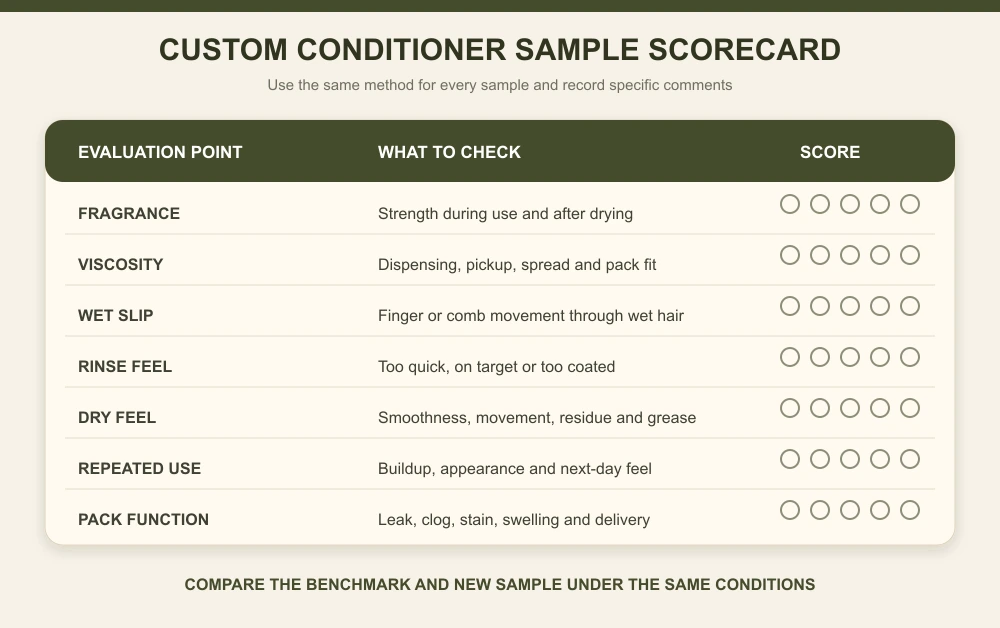
Do not rely on “I like it” or “make it more premium.” Use the same scorecard for each sample and record the use method.
| Evaluation point | Question for the buyer or test panel | Example rating method |
|---|---|---|
| Appearance | Is the color and finish right for the concept? | Accept / revise, with a physical reference |
| Fragrance | Is the strength suitable during use and after drying? | 1 to 5, checked at fixed times |
| Viscosity and pickup | Does the product dispense and spread as intended? | 1 to 5 plus packaging observation |
| Wet slip | Does it help fingers or a comb move through the hair? | 1 to 5 on a defined tress or user group |
| Rinse feel | Does it rinse too quickly, too slowly, or as intended? | Light / target / heavy |
| Dry feel | Is the hair smooth, coated, rough, or greasy? | 1 to 5 plus written note |
| Residue and buildup | Does repeated use change feel or appearance? | Compare after a defined number of uses |
| Pack compatibility | Does the formula dispense, leak, stain, swell, or clog? | Pass / fail with observations |
Test the benchmark and new sample under the same conditions. Use the same amount, hair substrate, wash method, drying method, water conditions, and evaluation time. If several people approve samples, combine their feedback into one document before sending it to the factory.
Testing should follow the formula, claims, packaging, and market
A good beaker sample is not the final product. Before commercial release, the project team should define the required stability work, microbiological controls, packaging compatibility checks, specifications, and claim support.
The exact program depends on the formula, pack, sales country, and claims. A hair mask in a jar creates different use and contamination considerations from a leave-in spray in a closed pump. A new fragrance or color can also change stability or compatibility.
Ask the manufacturer to state:
- which tests are included in the quotation;
- which tests require a third-party laboratory;
- the sample and packaging used for each test;
- the acceptance criteria;
- who owns the reports;
- what happens if the formula or pack changes after testing begins.
Our article on how a hair care manufacturer tests formula stability explains why formula, packaging, and storage conditions should be considered together.
How SEVICH develops a custom conditioner formulation
A SEVICH project can start with a mature formula, an adjustment to a SEVICH formula, a customer’s reference sample, or a customer-provided written formula. Depending on feasibility, the R&D team can review changes to ingredient choices or proportions, fragrance, color, texture, and the intended sensory result.
The team then reviews the fill size and packaging. Options may include plastic or glass containers, bottles, tubes, jars, labels, and folding cartons. Available decoration depends on the component and supplier.
Once the brief is clear, a new custom formula sample normally takes about 7 business days. The buyer reviews the sample and sends one consolidated set of comments. If the sample needs changes, both sides agree on the next revision before bulk approval.
After formula, packaging, and artwork approval, a 30% deposit moves the project into bulk preparation and production. SEVICH checks incoming packaging, carries out inspections on the production line, and performs a finished-goods inspection. Normal bulk production planning is about 25 business days after the required approvals, payment, and materials are ready. Freight time is separate.
Review SEVICH’s hair conditioner OEM/ODM services, daily care conditioner options, deep conditioning and hair mask options, and factory and R&D capabilities before sending your brief.
Request custom conditioner formula samples
Send SEVICH your primary hair need, product format, required results, ingredient rules, sales country, fill size, packaging idea, quantity per SKU, and target cost range. The team will review whether a mature formula, adjusted formula, or new custom conditioner formulation fits the project, then recommend a sample route.
You can also ask for available distributor support and agency policy for your market in the same inquiry.
Frequently asked questions
What information does a manufacturer need for a custom conditioner formulation?
The manufacturer needs the target user, primary hair need, product format, required results, texture and fragrance direction, ingredient rules, sales country, claims, fill size, packaging, quantity, cost range, and delivery date. A reference product can help, but the brand should explain which features it wants to match.
Which ingredients are used in a conditioner formulation for dry hair?
Dry-hair conditioners often combine cationic conditioning agents, fatty alcohols, and selected emollients or film formers. Proteins, polymers, oils, silicones, humectants, and other materials may be added when they fit the target. The choice and use level must be assessed as part of the full formula, not as a shopping list.
Should a curly-hair brand choose a rinse-off or leave-in conditioner?
Choose the format based on the routine. A rinse-off conditioner can focus on shower detangling and rinse feel. A leave-in can support ongoing softness and styling. Some ranges need both, especially when the brand serves customers with different strand thicknesses or preferred weight levels.
Can one conditioner work for dry, curly, color-treated, and fine hair?
It can serve overlapping needs, but the brand must set priorities. A very rich formula for dry curls may feel heavy on fine hair. A lightweight formula may not give highly damaged hair enough slip. State one primary need and treat the others as design constraints, or create separate products.
How long does a custom conditioner sample take?
At SEVICH, a new custom formula sample normally takes about 7 business days after the brief is clear. Formula complexity, raw material sourcing, packaging samples, and revision rounds can change the schedule. The written project plan should state the confirmed timing.
What is the MOQ for a custom conditioner?
SEVICH’s typical planning MOQ is 2,000 to 5,000 units per product. The formula, fill size, container, closure, printing, and component supplier minimums affect the final quantity. Check the MOQ for each formula, size, fragrance, and design rather than treating the entire order as one SKU.
What tests should a private label conditioner brand request?
The test plan should cover the formula’s safety and stability needs, microbiological controls, packaging compatibility, finished-product specifications, and support for the intended claims. Requirements vary by formula, packaging, market, and claim, so ask the manufacturer and a qualified regulatory professional to define the project-specific program before sale.