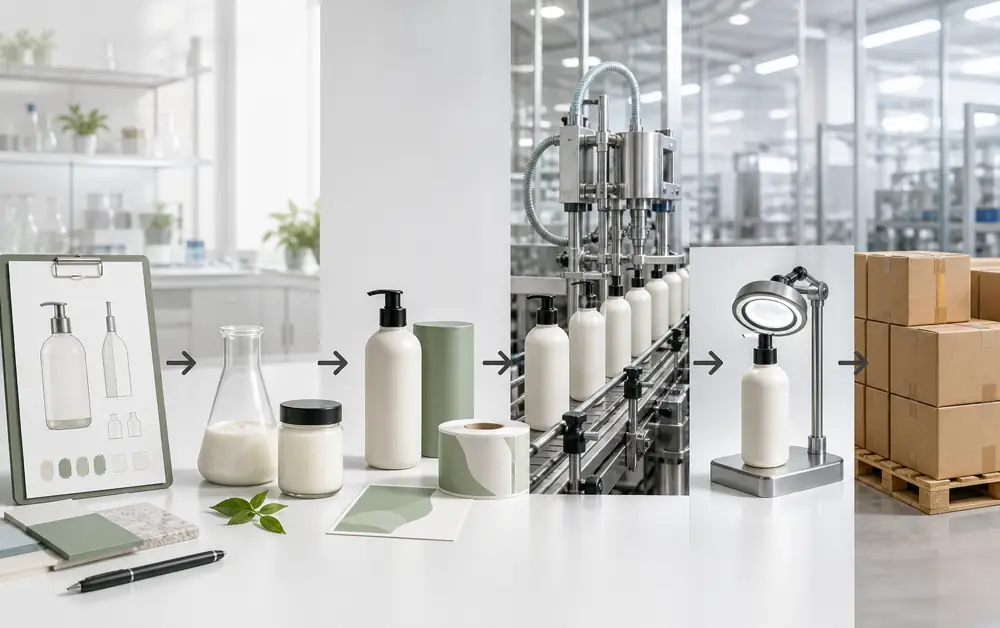
A custom conditioner development timeline starts with a clear product brief. The factory then selects or develops the formula, confirms the packaging, prepares samples, and collects written approvals. At SEVICH, a new custom formula sample normally takes about 7 business days. After the formula, packaging, and artwork are approved, the client pays a 30% deposit. Bulk production then normally takes about 25 business days. International freight and customs time are separate.
The schedule changes when a formula needs several revisions, packaging is made to order, artwork is incomplete, or the target market requires extra testing. The written project plan and quotation are the final references for each order.
Custom conditioner development timeline at a glance
There is no reliable total lead time until the product specification is clear. A mature formula in a standard bottle moves faster than a new formula in custom packaging. The table below shows the usual SEVICH workflow and the planning figures that are already known.
| Stage | Typical SEVICH planning figure | What must happen before the next stage |
|---|---|---|
| Product brief and feasibility review | Project specific | Confirm product type, target user, market, quantity, packaging direction, and launch date |
| Stock sample | 1 to 3 business days | Buyer selects a mature formula for evaluation |
| New custom formula sample | About 7 business days | Buyer supplies a clear brief and reference details |
| Sample review and revision | Depends on feedback and revision rounds | One decision-maker sends consolidated comments |
| Packaging preparation | About 10 to 20 days when applicable | Bottle, closure, decoration, label, and carton are approved |
| Bulk production | About 25 business days | Formula, packaging, artwork, deposit, and required materials are ready |
| Filling | About 2 to 3 days within the production schedule | Bulk formula and packaging pass the required checks |
| Inspection | About 1 to 2 days within the production schedule | Packaging, line, and finished-product checks are completed |
| Balance and shipment | Project specific | Buyer pays the balance and confirms shipping details |
The 10 to 20 days for packaging preparation, 2 to 3 days for filling, and 1 to 2 days for inspection sit inside the wider project schedule when the work can be coordinated. Do not add every figure together without checking the project plan. Some activities can overlap. Others must wait for a signed approval.
Planning answer: For a new custom conditioner, allow about 7 business days for the first formula sample and about 25 business days for bulk production after all approvals, the deposit, and material readiness. Add time for revisions, packaging, tests, freight, customs, and local delivery.
What starts the conditioner product development process?
The process starts with a product brief that a formulator, packaging buyer, and production planner can use. “Premium conditioner for all hair types” is not enough. The factory still needs to know what the product should do, how it should feel, where it will be sold, and how it will be packed.
A useful brief answers these questions:
| Brief item | Information to provide | Why the factory needs it |
|---|---|---|
| Target customer | Hair condition, routine, price position, and sales channel | Guides the product format and sensory target |
| Product format | Rinse-off conditioner, leave-in, spray, cream, or hair mask | Affects formula, viscosity, filling, and packaging |
| Performance target | Wet slip, detangling, softness, light feel, rich feel, shine, or another defined result | Gives the lab a sample scorecard |
| Formula direction | Mature formula, adjustment, reference sample, or written formula | Sets the R&D route and sampling work |
| Ingredient rules | Required, preferred, and excluded ingredients | Helps the team review feasibility and sourcing |
| Fragrance, color, and texture | Reference, intensity, shade, and viscosity direction | Reduces subjective revision comments |
| Claims | Proposed front-label and marketing statements | Affects testing, evidence, and regulatory review |
| Sales market | Country or region where the product will be sold | Affects formula, label, documents, and compliance work |
| Fill size and packaging | Volume, bottle or jar, material, closure, decoration, label, and carton | Affects cost, compatibility, supplier MOQ, and timing |
| Quantity | Units per formula, size, fragrance, and design | Allows an accurate production and packaging plan |
| Commercial target | Target cost range and required warehouse date | Helps the manufacturer identify a workable route |
Send one version of the brief to every supplier you compare. Otherwise, one conditioner manufacturer may quote a mature formula and a standard bottle while another prices a new formula and decorated packaging. The totals will not describe the same project.
For help defining the product before sampling, use our guide to choosing a custom conditioner formulation for dry, curly, color-treated, and fine hair.
Step 1: Choose the formula development route
SEVICH can start a conditioner project in four ways:
- The buyer selects a mature SEVICH formula.
- The lab adjusts a SEVICH formula, such as the fragrance, color, texture, ingredient choice, or ingredient proportion, subject to feasibility.
- The buyer sends a reference sample for the team to study and develop toward a similar fragrance, texture, ingredient direction, or sensory result.
- The buyer provides a written formula for manufacturing and feasibility review.
These routes do not require the same amount of work. A mature formula is usually the most direct option for a first launch. An adjusted formula adds a controlled point of difference. A reference match or buyer-owned formula needs a better technical brief and may need more development work.
If confidentiality matters, raise it before sending a formula or sensitive sample. Ask who can access the material, how it will be used, what the nondisclosure agreement covers, and what happens to retained samples and documents. Formula ownership and exclusivity should be written into the commercial agreement. Do not rely on the words “OEM” or “private label” alone.
Our conditioner OEM vs ODM vs private label guide explains how these routes overlap and what to confirm in a quotation.
Step 2: Develop and evaluate the conditioner sample
A stock sample is normally ready in 1 to 3 business days. A new custom formula sample normally takes about 7 business days after the brief is clear. Delivery by courier is separate from sample preparation time.
The first sample is a working answer to the brief. It is not a cue for a general reaction such as “make it more premium.” Buyers get better results when they score the same points each time:
- appearance and color;
- fragrance during use and after drying;
- viscosity, pickup, and spreading;
- wet slip and detangling;
- rinse feel;
- dry softness, residue, and weight;
- performance in the intended bottle, jar, tube, or pump.
Test the sample and benchmark under the same conditions. Use the same dose, hair type or tress, wash method, water conditions, drying method, and evaluation time. If several people take part, appoint one project owner to combine their notes. Contradictory comments from sales, design, and product teams can turn one revision into three.
When a sample misses the target, describe the gap. “The fragrance is too strong after drying” is useful. “It does not feel luxurious” is not. Attach photos, scorecards, or a physical reference when they clarify the request.
Step 3: Confirm the bottle, closure, label, and carton
Packaging is part of the conditioner development process, not a task to leave until the formula is finished. A thick mask may not dispense through a narrow pump. A leave-in spray needs a formula that works with the selected sprayer. Fragrance, color, viscosity, and packaging materials can affect compatibility.
SEVICH can review capacity, material, shape, and appearance for bottles, tubes, jars, or other suitable packs. Label and carton options may include matte, gloss, or frosted effects. Special decoration can include embossing, hot stamping, or UV effects when the selected component and supplier support them.
Ask the custom conditioner manufacturer to confirm:
| Packaging point | Approval needed |
|---|---|
| Container and closure | Material, capacity, neck finish, cap, pump, sprayer, liner, and color |
| Formula fit | Filling method, dispensing, leakage, staining, swelling, clogging, and product pickup |
| Decoration | Label, screen print, hot stamp, coating, embossing, UV effect, and color reference |
| Secondary pack | Folding carton material, finish, insert, case pack, and shipping protection |
| Supplier status | Stock item, made-to-order item, custom color, or custom mold |
| Quantity | MOQ and allowed overrun or underrun for each component |
| Timing | Sample preparation, buyer approval, production, and delivery to the filling site |
Client-supplied packaging can be possible, but it still needs specifications, delivery timing, inspection, and a compatibility review. The factory also needs an agreed process for damaged parts, shortages, excess components, and unused stock. Fill-only work should not be scheduled as if the packaging were already approved and at the factory when it is still in transit.

Step 4: Complete artwork and market review before approval
Artwork can hold up a private label conditioner timeline even when the formula and bottle are ready. The design team needs the final dieline, print method, barcode, colors, ingredient declaration, net contents, directions, warnings, responsible company details, and market-specific text.
The brand owns the final marketing claims and market entry decisions. A factory can provide manufacturing documents and practical label support, but the buyer should arrange qualified regulatory review for the target country before approving print files.
For the United States, the FDA states that cosmetic products and ingredients, other than color additives, do not need FDA approval before sale. Companies remain responsible for product safety and proper labeling. MoCRA also created requirements that can include safety substantiation, facility registration, and product listing. Read the FDA Cosmetics and U.S. Law overview and the FDA cosmetic labeling regulations page. Do not print “FDA approved” on an ordinary cosmetic product.
For the European Union, the European Commission cosmetics legislation page links to Regulation (EC) No 1223/2009 and the common criteria for cosmetic claims. The Responsible Person, safety assessment, Product Information File, notification, label, and claim review need to fit the product and market. CPNP notification is not a factory certificate.
Do not release artwork while the formula or claims are still changing. A revised fragrance, colorant, ingredient, fill quantity, warning, or product name can require a new label review. Printed packaging is expensive to correct after approval.
Step 5: Sign off the final specification
Bulk conditioner production should not start from scattered emails and verbal comments. The approved specification should identify the exact formula, fragrance, color, viscosity range or other agreed product criteria, fill amount, packaging components, decoration, artwork version, case pack, testing scope, quantity, and acceptance process.
A practical sign-off pack can include:
- an approved formula or product specification reference;
- an approved physical sample or documented sensory standard;
- packaging component specifications;
- signed artwork files and color references;
- agreed finished-product and packaging checks;
- the quotation, payment terms, Incoterm, and shipping destination;
- written responsibility for market compliance and any third-party testing.
This is the point to settle change control. If the buyer changes the formula, bottle, print file, quantity, or sales market after sign-off, the manufacturer should review the price, materials, tests, and production slot again. A small design change can affect more than the artwork if printed components are already in production.
Step 6: Pay the deposit and release materials
At SEVICH, the buyer pays a 30% deposit after the formula, packaging, and design are confirmed. The deposit releases the bulk order process under the terms of the quotation. Payment methods may include PayPal, Western Union, or T/T, subject to the invoice and agreed order terms.
The team then coordinates raw materials and packaging. Packaging preparation commonly takes about 10 to 20 days, depending on the component, decoration, stock status, and supplier. A custom mold, special color, or unusual closure can take longer, so the confirmed purchase plan should replace any general estimate.
Buyers sometimes ask whether formula work, packaging, and artwork can run in parallel. They can overlap when the team has enough confirmed information. For example, designers can work from an approved bottle dieline while the final formula sample is under review. Printing should wait when the formula, ingredient list, claims, or fill statement may still change.
Step 7: Schedule bulk conditioner production
SEVICH normally plans about 25 business days for bulk production after the required approvals, deposit, and materials are ready. That period covers more than mixing and filling. It includes material coordination, production planning, batching, line setup, in-process work, filling, packing, and inspections.
Filling often takes about 2 to 3 days within the wider production schedule. Inspection often takes another 1 to 2 days within the same schedule. These figures can change with batch size, viscosity, packaging format, line availability, and the agreed quality plan.
ISO 22716 gives guidance for cosmetic production, control, storage, and shipment. It helps buyers understand why records, material controls, hygiene, production procedures, and quality checks sit inside the schedule. See the official ISO 22716 page. ISO 22716 is a manufacturing practice standard, not proof that a conditioner delivers a marketing claim.
The project manager should confirm the planned production window, but brands should avoid announcing a fixed retail launch date based only on the filling date. Finished goods still need inspection, balance payment, freight booking, export handling, customs clearance, and local delivery.
Step 8: Complete three quality checkpoints
SEVICH uses three checkpoints in the order flow described for custom projects:
- Packaging inspection checks the incoming components before use.
- Production-line inspection checks the product and pack while the order is running.
- Finished-goods inspection checks the completed order before shipment.
The exact test and inspection plan should match the product. A rinse-off conditioner in a flip-top bottle and a thick hair mask in a jar do not have identical risks. Agree on specifications, sampling method, acceptance criteria, photos, reports, and any third-party inspection before production.
Testing also needs to match the formula, packaging, claims, and destination market. Stability work, microbiological controls, packaging compatibility, and claim support should be defined before commercial release. Read how a hair care manufacturer tests private label formula stability for the questions to ask before scale-up.
SEVICH can provide production photos when this is agreed for the project. The buyer should specify which stages or views are needed and whether the images are for approval, internal records, or marketing. White-background product images can also be discussed before shipment, but they should not replace an agreed inspection record.

Step 9: Approve the finished order, pay the balance, and ship
After production and the agreed inspections, SEVICH can send finished-order photos for confirmation. The buyer pays the balance, and the shipping arrangement moves forward under the quotation and Incoterm.
Freight is a separate part of the calendar. The shipment plan should state:
- pickup location and destination;
- Incoterm;
- carton count, weight, and volume when available;
- air, sea, rail, courier, or another agreed mode;
- export and import document responsibilities;
- consignee and customs broker details;
- estimated transit time and local delivery arrangement.
An estimated departure or arrival date is not a guarantee. Carrier space, customs review, port conditions, weather, and local delivery can change the schedule. Build a buffer between warehouse receipt and the public launch date. This gives the team time to count stock, inspect transit condition, prepare fulfillment inventory, and handle any exception.
Which stages can overlap, and which cannot?
Parallel work can shorten the project, but only when it does not create rework. Use this guide when building the custom conditioner development timeline.
| Workstream | Can it overlap? | Main caution |
|---|---|---|
| Formula sampling and stock packaging search | Usually | Do not order a closure before checking viscosity and dispensing needs |
| Artwork layout and formula review | Partly | Ingredient list, claims, net contents, and warnings must be final before print approval |
| Packaging production and bulk formula planning | After specifications are stable | A late pack change can affect filling setup and the production slot |
| Regulatory review and artwork development | Yes | Regulatory comments must return before artwork sign-off |
| Test planning and sample development | Yes | The final test program must use the approved formula and intended pack where required |
| Bulk manufacturing and final formula approval | No | Production needs an approved formula and specification |
| Printing and unfinished artwork | No | A buyer should not approve print files that still contain provisional text |
| Shipment release and final balance | No under SEVICH’s stated order flow | The balance is paid before shipment arrangement |
Fast projects are not rushed projects. They are projects with fewer open decisions. A mature formula, a standard bottle, one artwork owner, and prompt written approvals remove waiting time without removing control.
What commonly delays a private label conditioner timeline?
Most preventable delays appear at handoffs, not on the mixing line.
- The brief changes after sampling starts.
- Several buyer-side approvers send separate or conflicting comments.
- A reference product is supplied without explaining which qualities matter.
- The bottle, pump, or jar is selected without considering viscosity and dispensing.
- The label is designed before the ingredient list, claims, fill amount, or target market is final.
- A custom color, special decoration, unusual closure, or new mold is treated like a stock component.
- Client-supplied packaging arrives late, short, damaged, or outside specification.
- The sales market changes after formula or artwork approval.
- The deposit, balance, or shipping instructions arrive after the agreed date.
- The public launch date leaves no buffer for freight, customs, or receiving checks.
The simplest prevention method is a decision log. Record the item, version, decision-maker, approval date, and effect on cost or timing. When a change is requested, ask the manufacturer to state whether the quote, sample, testing plan, material order, or production window also changes.
Buyer checklist before requesting a production date
Use this checklist before asking a conditioner OEM factory to confirm the bulk schedule:
- Product format and target user are defined.
- Formula route is selected.
- Final formula sample is approved in writing.
- Bottle, closure, label, carton, and decoration are approved.
- Formula and packaging compatibility work is agreed.
- Final artwork version has passed market review.
- Quantity per SKU is confirmed.
- Testing, documents, and acceptance criteria are agreed.
- Quotation, payment terms, Incoterm, and destination are confirmed.
- Deposit is paid under the invoice terms.
- Buyer-side approver and response time are clear.
- Freight, customs, warehouse receipt, and launch buffer are in the calendar.
For quantity and budget planning, read the private label conditioner MOQ, cost, and lead time buyer’s guide. SEVICH’s usual planning MOQ is 2,000 to 5,000 units per product, but the formula, pack, size, decoration, and component supplier minimums set the confirmed figure.
How SEVICH manages a custom conditioner project
SEVICH has more than 10 years of hair care manufacturing and sales experience. The company provides OEM, ODM, and private label services. Its stated production resources include a 10,000 square meter factory, more than 300 production employees, and 20 production lines. SEVICH reports work with more than 600 brands.
Those figures help a buyer understand capacity, but they do not replace a project-specific review. The team still needs the formula route, packaging, target market, quantity, testing scope, and required delivery date before confirming a custom conditioner development timeline.
The normal order flow is:
- Review the product brief and select the formula route.
- Confirm bottle, closure, label, carton, and decoration direction.
- Prepare and deliver the sample.
- Revise the sample if the buyer requests an agreed change.
- Approve the formula, packaging, artwork, quotation, and project requirements.
- Pay the 30% deposit and release the bulk order.
- Inspect packaging, check the production line, and inspect finished goods.
- Send finished-order photos when agreed.
- Receive the balance and arrange shipment.
Review our hair conditioner OEM/ODM services, daily care conditioner range, deep conditioning and hair mask options, and factory and R&D capabilities before sending the brief.
Request a custom conditioner project timeline
Send SEVICH your target customer, product format, formula direction, benchmark, ingredient rules, fragrance and texture target, fill size, packaging idea, sales country, quantity per SKU, cost range, and required warehouse date.
The team will review the critical path and reply with the suitable development route, sample plan, planning MOQ, packaging steps, bulk production target, and quotation. You can also ask about fill-only manufacturing, bulk semi-finished product supply, formula confidentiality, project photography, distributor support, and SEVICH’s agency policy for your market.
Recommended visible fields: Name, Email, WhatsApp, OEM/ODM Quantity, Products of Interest, Target Market, Packaging Direction, and Required Warehouse Date. Add an optional checkbox for Distributor or Agency Policy.
Frequently asked questions
How long does custom conditioner development take?
At SEVICH, a new custom formula sample normally takes about 7 business days after the brief is clear. Bulk production normally takes about 25 business days after formula, packaging, artwork, deposit, and material readiness. Revisions, packaging preparation, testing, freight, customs, and local delivery add time. The written project schedule is the final reference.
When does the 25-business-day bulk production period start?
It does not start when the first inquiry or sample request is sent. The bulk period starts after the required formula, packaging, artwork, commercial terms, and other project details are approved, the 30% deposit is paid, and the required materials are ready. The quotation should state the exact release conditions.
Can formula development and packaging design happen at the same time?
Some work can overlap. The team can search stock packaging and prepare a dieline while the formula is under review. Final printing should wait until the formula, ingredient declaration, claims, net contents, warnings, and market requirements are stable. The formula also needs to dispense correctly from the selected package.
How many conditioner sample revisions are included?
The number of revisions is project specific and should be written into the quotation. A clear brief and one consolidated feedback document usually reduce revision rounds. A new target, new benchmark, new fragrance, or major ingredient change may require a new development review rather than a small adjustment.
Can I send my own formula or reference conditioner sample?
Yes. SEVICH can review a buyer-provided written formula or a reference sample. A reference match should define which features matter, such as fragrance, color, texture, wet slip, rinse feel, or dry feel. Raw material availability, safety, intellectual property, market rules, and process differences can affect feasibility. Exact duplication should not be assumed.
Can I supply my own bottles and ask the factory to fill them?
Client-supplied packaging and fill-only manufacturing can be discussed. The factory needs component specifications, quantities, arrival dates, inspection criteria, and enough parts for the agreed production plan. The formula and pack also need a compatibility review. The agreement should cover shortages, damage, unused components, and responsibility for delays.
What is the biggest cause of delay in a private label conditioner project?
There is no single cause for every project. Common delays include an incomplete brief, slow or conflicting approvals, repeated formula changes, unfinished artwork, made-to-order packaging, late client-supplied components, and a market change after approval. A named decision-maker and written approval log prevent many of these problems.