Quick Takeaways for Hair Brands:
- The Problem: Most purple conditioners stain hands and bathroom grout while leaving bleached hair dry and brittle.
- The Solution: Use high-purity Acid Violet 43 buffered to pH 4.0 to 4.5. This seals cuticles and prevents dye bleeding onto skin.
- Moisture: Add plant hemisqualane, argan oil, and amino acids to replace stripped natural lipids and stop breakage.
- Factory QC: Maintain spectrophotometer Delta-E under 0.8 across bulk tanks, and package in opaque UV-blocking bottles.
Every colorist knows that bleach reveals stubborn warm tones. Human hair contains eumelanin (brown-black pigment) and pheomelanin (red-yellow pigment). Bleach breaks down eumelanin quickly, but pheomelanin stays trapped inside the cortex.
When hair lifts to pale blonde (levels 8, 9, or 10), residual yellow tones always show through. Violet sits opposite yellow on the color wheel. Depositing a microscopic layer of violet dye onto the hair fiber cancels out the yellow light reflections, making blonde hair look clean, cool, and bright.
Cuticle Surface Deposition: How Purple Conditioner Works
Bleached Hair Cuticle (Untreated, pH 6.5 to 7.5):
- Chipped, lifted cuticle scales with strong negative charge
- Loss of natural 18-MEA protective lipid shield
After Acidic Toning Conditioner (pH 4.0 to 4.5):
- Acidic buffer contracts and closes open cuticle scales
- Positively charged base binds violet dye selectively to damaged keratin
- Protective plant oils seal the surface so dye does not run off on towels
You can review official regulatory standards for cosmetic color additives here:
- Official external-link opportunity: U.S. FDA Color Additives Permitted in Cosmetics (21 CFR Part 73/74) [Official US FDA Portal]
- Official external-link opportunity: European Commission CosIng Database for CI 60730 / Acid Violet 43 [Official EU Commission Database]
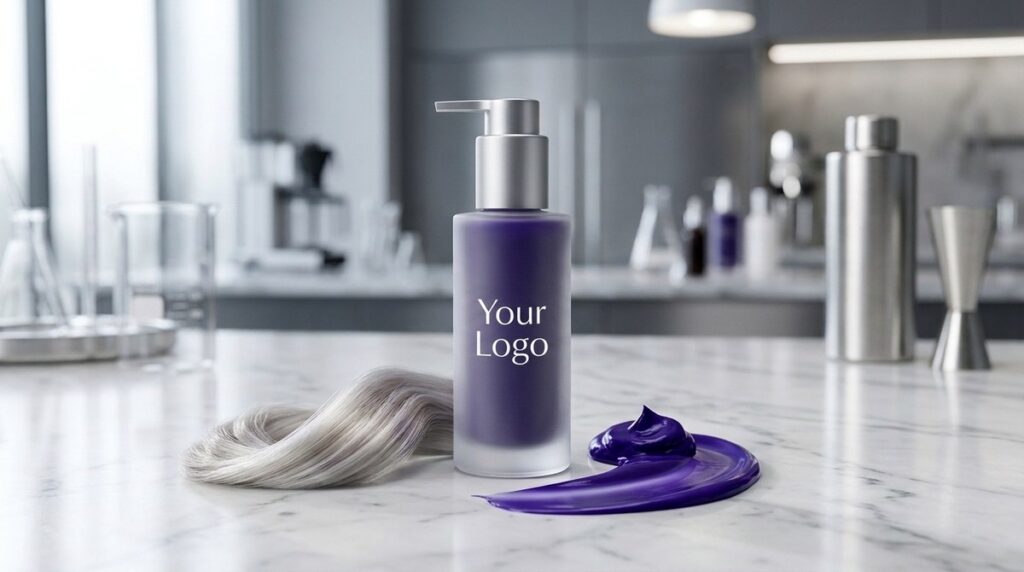
2. Solving the Two Biggest Flaws: Staining and Straw-Like Dryness
If you read one-star reviews on Amazon for purple conditioners, you will see two complaints over and over: “My hands turned purple” and “My hair feels like straw.”
Here is how our formulation lab fixes both issues in production.
Problem 1: Purple Stains on Hands, Nails, and Shower Grout
Budget brands often use cheap basic dyes or dump raw pigment into a thin lotion base. Small basic dye molecules easily migrate into dry skin crevices, staining hands and leaving stubborn marks on bathroom tile grout.
How We Fix It in the Lab:
- We use high-purity Acid Violet 43: Acid dyes have larger molecular structures than basic dyes. They sit on the outer cuticle scales of the hair and rinse cleanly from living skin during a standard shower rinse.
- We control pigment concentration strictly: The active dye content must stay between 0.015% and 0.045%. If you exceed 0.06%, the conditioner will stain hands and turn porous hair ends dull purple.
- Cationic carrier synergy: We suspend the violet dye inside an emulsion of Cetrimonium Chloride and Behentrimonium Methosulfate. Because damaged bleached hair carries a negative charge, this positively charged base pulls the pigment straight to the hair shaft and away from porcelain tubs.
Problem 2: Dry, Rough, Brittle Bleached Hair
Bleaching strips away hair’s natural 18-MEA fatty acid layer. Many toning shampoos and cheap conditioners use harsh salts that dehydrate this already damaged fiber, leaving hair stiff and hard to comb.
How We Fix It in the Lab:
- Strict acidic pH balance (4.0 to 4.5): Healthy hair settles naturally near pH 3.7. Buffering our toning conditioner between pH 4.0 and 4.5 forces the raised cuticle scales to lie flat, trapping moisture inside the core.
- Lipid replacement: Bleached hair needs lipids immediately. We blend vegetable squalane, argan oil, and light plant esters into the emulsion to restore soft slip without muddying the blonde tone.
- Smart detangling polymers: We add amodimethicone or sugarcane hemisqualane. These ingredients reduce wet combing friction by over 50% and protect hair from hot tools up to 230°C.
Read our lab breakdown of conditioning agents: Silicone-Free vs Dimethicone Conditioner: The Science, Hair Myths, and What Private Label Brands Must Know.
3. Pigment Selection Guide: Which Dyes Fit Your Target Product?
Choosing the right colorant affects product safety, shelf life, and whether retailers will accept your brand.
| Pigment (INCI & Common) | Toning Action | Staining Risk | Compliance & Best Use |
|---|---|---|---|
| Acid Violet 43 (CI 60730) Ext. D&C Violet No. 2 |
Deposits on cuticle surface to cancel yellow tones | Very Low Rinses easily from skin |
FDA & EU Approved Best: Daily & weekly blonde toners |
| Basic Blue 99 + Basic Red 76 Mixed Basic Direct Dyes |
Blends blue and red to cancel orange brass | Moderate Can cling to dry skin |
Strict purity limits Best: Brunette anti-orange lines |
| HC Blue No. 2 + HC Violet 1 Semi-Permanent Direct Dyes |
Enters cuticle slightly for longer-lasting color | High Requires gloves |
Regulated limits Best: Intense salon toning masks |
| Spirulina / Blueberry Extract Botanical Extracts |
Tints the cream visually in the bottle | Zero Non-staining |
100% Clean / Natural Best: Clean beauty storytelling |
To verify safety testing data on cosmetic hair colorants, see the Official external-link opportunity: Cosmetic Ingredient Review (CIR) Hair Colorant Database [Official CIR Archive].
4. What Happens on the Factory Floor: Mixing, Stability, and Packaging
Making a 500 mL sample in a glass beaker is simple. Scaling that up to 3,000 kg inside a vacuum emulsification tank is where factory experience matters.
Factory Production Process for Purple Conditioners
- Dye Solubilization (Phase A): Pre-dissolve Acid Violet 43 powder in 65°C deionized water with high-shear mixing. Quality check: confirm zero undissolved specks or micro-granules.
- Hot Emulsification (Phase B): Blend cetyl alcohol and cationic conditioners at 75°C. Add citric acid buffer to lock the batch between pH 4.0 and 4.5.
- Color Verification (Phase C): Digital spectrophotometer reading to confirm Delta-E variance stays under 0.8. Centrifuge test at 3,000 RPM for 30 minutes to confirm dye suspension.
- Packaging and Filling (Phase D): Piston filling into opaque or UV-blocking bottles. In-line torque and induction seal checks to prevent shipping leaks.
1. Stopping Batch Color Drift
If your first production batch is pale lilac and your second batch is dark ink, your salon customers will send bottles back.
In our factory, we measure every finished bulk batch with a digital spectrophotometer. We track the color values (L*, a*, b*) and enforce a Delta-E variance under 0.8. This guarantees that every shipment matches your approved golden master sample.
2. Preventing Pigment Settlement
If the bulk viscosity drops below 15,000 cSt, heavy dye molecules can slowly settle to the bottom during ocean freight.
We formulate with lamellar gel networks. The conditioner pumps smoothly through dispensing nozzles, but stays thick enough in storage to keep pigments evenly suspended for its entire three-year shelf life.
Learn more about our quality control tests: How a Hair Care Manufacturer Tests Stability for Private Label Formulas.
3. Bottle Selection and Sunlight Fading
Violet direct dyes break down under direct sunlight and retail fluorescent bulbs. If you put a purple conditioner into a clear transparent bottle, the formula can fade into a dull brown-grey within two months.
- Best bottle materials: Opaque white or colored HDPE bottles, aluminum tubes, or UV-inhibited PCR PET containers.
- Pump design: Heavy-duty lotion pumps with internal spring seals to prevent air exposure and nozzle dripping.
Read our guide to packaging choices: Private Label Conditioner Packaging: PCR PET, Aluminum Tubes, and Recycled Materials.
5. Three Profitable Toning Products Your Brand Can Launch
Depending on your distribution channel and customer base, you can position your color care line in three ways:
Product 1: The Daily Blonde Maintenance Conditioner (Low Pigment, High Slip)
- Target Audience: Platinum blondes, gray hair, and daily washers who want gradual tone control.
- Formula Specs: 0.015% Acid Violet 43, pH 4.2, loaded with plant hemisqualane and aloe extract.
- Retail Channel: Amazon FBA, TikTok Shop, retail stores ($16 to $24 retail price).
- Selling Point: Safe for daily use. Never turns blonde ends purple or over-deposits.
Product 2: The Salon Intensive Purple Hair Mask (High Pigment, Deep Moisture)
- Target Audience: Salon clients with bleached, balayage, or double-processed hair.
- Formula Specs: 0.045% Acid Violet 43, pH 4.0, packed with plant keratin, argan oil, and amino acids.
- Retail Channel: Professional hair salons, medspas, and high-end beauty boutiques ($32 to $48 retail price).
- Selling Point: Eliminates bright orange-yellow brass in a single five-minute treatment while softening coarse hair.
Product 3: The Blue-Violet Toning Mask for Brunettes (Anti-Orange)
- Target Audience: Dark hair with caramel or honey balayage highlights that turn brassy orange.
- Formula Specs: A balanced mix of Basic Blue 99 and Acid Violet 43.
- Retail Channel: E-commerce stores and stylist private labels ($26 to $36 retail price).
- Selling Point: Removes brass from dark hair without turning blonde highlights muddy.
Check out our full formulation menu: How to Choose a Custom Conditioner Formulation for Dry, Curly, Color-Treated, and Fine Hair.
6. Manufacturing Your Color Care Line with Sevich
Color-depositing hair products demand tight quality control and complete regulatory compliance.
At Sevich, we offer over 10 years of contract manufacturing and export experience. Our 10,000 square meter factory runs 20 automated production lines with more than 300 experienced workers. We handle over $15 million in annual exports, with $8 million going to brand partners in Europe and North America.
What We Provide for Private Label Brands:
- Custom Colorimetry Matching: Select from our proven library of toning bases or let our chemists match your specific pigment target, viscosity, and fragrance in 3 to 7 working days.
- Flexible Low MOQs: Starting tiers between 2,000 and 5,000 units depending on your bottle selection, letting you launch new color SKUs without tying up heavy capital.
- Rapid Turnaround: Pre-existing sample benchmarks ship in 1 to 3 working days. Custom lab formulations are ready in 7 working days, with 3 to 5 sample containers dispatched via DHL or FedEx (5 to 10 days delivery). Full commercial production finishes in 25 working days.
- Three-Stage Quality Control (3-Tier QC): We run three full inspections: incoming raw packaging checks, automated in-line process monitoring, and finished batch stability and microbiology release testing.
- Green and Sustainable Formulations: Our bases reach an 82% biodegradability rate, with 63% bio-based mineral and plant materials. We provide 83% recycled PET bottle options to support your clean beauty story.
- Certified Global Compliance: We hold ISO 22716, ISO 9001, GMPC, CE, CPSR, CPNP, PIF, MSDS, and US FDA facility registrations. We are officially approved under the Cruelty Free International Leaping Bunny Programme.
- Strict Formula Confidentiality: We sign Non-Disclosure Agreements (NDAs) to safeguard your custom color balances, active ingredients, and fragrance notes.
Review our plant operations on our Factory R&D Overview and Certifications & Compliance pages.
Ready to Launch Your Private Label Purple Conditioner?
Whether you need a daily anti-brass conditioner or an intensive salon purple treatment mask, our formulation chemists can build, bottle, and test custom prototypes for your brand.
Frequently Asked Questions (FAQ)
1. What is the difference between a purple shampoo and a purple conditioner?
Purple shampoos use surfactants to cleanse the scalp while depositing violet pigments onto the cuticle. However, shampoo surfactants open the hair cuticles, which can leave bleached hair feeling dry and rough. A purple conditioner uses an acidic pH between 4.0 and 4.5 to close the cuticle down. This seals the violet dye inside the hair while infusing fatty alcohols, plant oils, and detangling slip.
2. Can a purple conditioner stain hands, skin, or bathroom tiles?
Poorly formulated products with cheap basic dyes or high pigment levels can stain skin and grout. Professional OEM formulas use high-purity Acid Violet 43 at calibrated levels between 0.015% and 0.045%. This allows the pigment to bind selectively to negatively charged hair cuticles while rinsing cleanly from skin and porcelain shower walls.
3. How often should consumers use a purple toning conditioner?
For regular blonde maintenance, consumers usually apply a purple conditioner 1 to 2 times per week. Overuse on porous bleached hair can cause over-toning, leaving a dull grey or lavender cast. Brands often recommend alternating between a weekly purple toning mask and a daily color-safe white conditioner.
4. What is the minimum order quantity (MOQ) for custom purple conditioner manufacturing?
At Sevich, our standard private label MOQ ranges from 2,000 to 5,000 units depending on your bottle packaging and custom formula specs. Standard stock sample benchmarks ship in 1 to 3 working days, custom formulation prototypes take 7 working days, and commercial batch production takes 25 working days.
5. Can you formulate a sulfate-free, vegan, and clean-beauty purple conditioner?
Yes. Our R&D lab regularly develops purple conditioners that meet Sephora and Ulta clean beauty standards. We eliminate sulfates, parabens, phthalates, and animal ingredients, using plant-based fatty alcohols, sugarcane hemisqualane, and conditioning agents approved under the Leaping Bunny cruelty-free program.
6. Can your factory match the toning strength of an existing salon benchmark?
Yes. Our colorimetry laboratory provides reverse engineering and benchmark matching. You can ship a physical bottle of your benchmark product to our lab. Our chemists will measure pigment absorption, viscosity, pH, and conditioning performance, delivering matched prototypes within 7 working days.
7. What compliance documents are required to export purple hair products to the US and EU?
In the United States, your manufacturing facility must have an active FDA cosmetic registration, and all color additives must follow 21 CFR rules. For the European Union and the UK, you need a complete Product Information File (PIF), a Cosmetic Product Safety Report (CPSR) signed by an EU-certified toxicologist, and a registration on the CPNP portal. Sevich provides full regulatory files, Certificates of Analysis (COA), and Safety Data Sheets (MSDS) for your brand.