Formulator Summary (Quick Takeaway for Brands and Buyers):
• Dimethicone is an inert, non-reactive synthetic silicone polymer. It provides unmatched wet slip, reduces detangling friction by up to 65%, shields against heat up to 230°C, and seals damaged cuticles without penetrating living tissue.
• Silicone-free conditioners replace silicones with plant-derived triglycerides, lightweight esters (such as Isoamyl Laurate), and hemisqualane. They deliver weightless volume and natural bounce without heavy buildup, making them ideal for fine hair, low-porosity hair, and “Clean at Sephora” positioning.
• Manufacturing reality: Formulating high-performance silicone-free conditioners costs 25% to 40% more in raw materials per kilogram compared to dimethicone emulsions.
• Brand verdict: Leading hair care brands often formulate both: an intensive dimethicone-based repair treatment for bleached or coarse hair, and a silicone-free daily conditioner for fine curls and clean-beauty retail shelves.
If you walk into our production lab on any given Tuesday, you will likely find our team testing two completely different batches of conditioner.
On one side of the room, a chemist is blending a salon grade mask with high viscosity dimethicone. On the other side, another team is testing plant esters and biotech hemisqualane for an indie clean-beauty startup.
Both formulas leave the hair feeling soft, but they behave differently on the hair fiber and in the factory reactor.
For brand owners, choosing between silicone-free and dimethicone is rarely about picking good versus bad. It is a business decision about retail positioning, customer hair types, and unit economics.
Here is what the chemistry actually looks like from inside a contract manufacturing plant.
1. The Surface Chemistry: What Happens on the Cuticle?
Hair condition is all about surface charges. When someone washes their hair with shampoo, the hair surface carries an anionic (negative) charge. Conditioners work by depositing positively charged ingredients and conditioning agents to smooth down rough cuticles.
How dimethicone and silicone-free alternatives achieve this smoothness is entirely different.
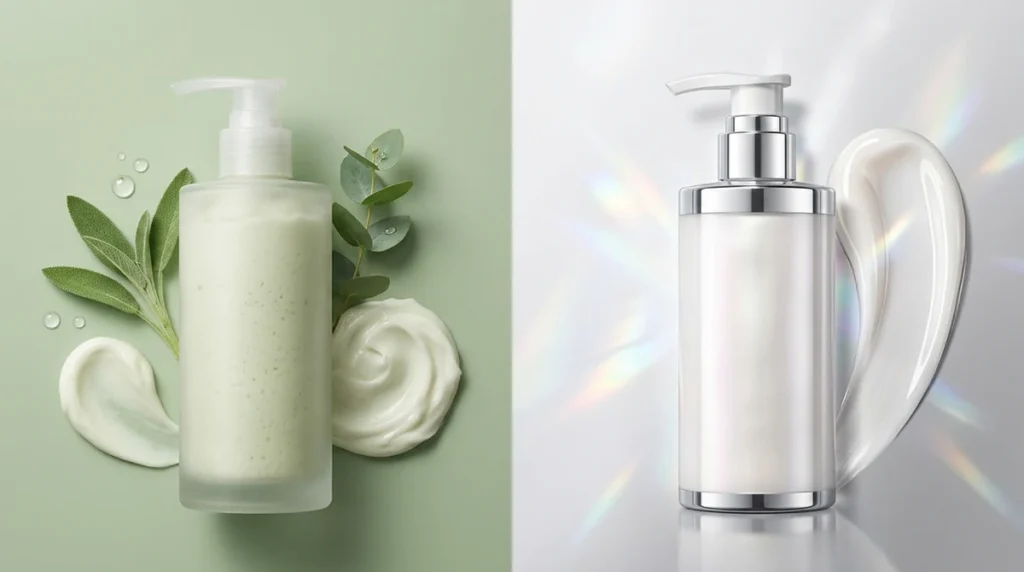
CUTICLE SURFACE DEPOSITION: HOW THEY COAT THE HAIR

[Dimethicone Barrier]
- Uniform hydrophobic film over lifted cuticles
- High refractive index for visible mirror shine
- Viscosity range: 350 cSt to 60,000 cSt
- Best fit: bleached, high-porosity, heat-damaged hair

[Silicone-Free Plant Esters and Hemisqualane]
- Discrete, breathable micro-layer across the fiber
- Natural bounce with low surface drag and zero greasy feeling
- Readily absorbed into porous cuticle gaps
- Best fit: fine strands, natural curls, sensitive scalps
What Dimethicone Actually Does
Dimethicone is polydimethylsiloxane (PDMS). Chemically, it is a stable backbone of alternating silicon and oxygen atoms capped with methyl groups.
In our mixing tanks, we use dimethicone fluid with viscosities from 350 cSt to 60,000 cSt depending on the product target.
- It lays down a continuous, water-repellent shield across the hair cuticle.
- It fills in chipped edges caused by bleaching, hair dyes, or heat styling.
- It drops wet combing resistance by over 50% immediately, which stops hair snapping when combed wet.
Dimethicone has decades of toxicology and safety data behind it:
- Official external-link opportunity: Cosmetic Ingredient Review (CIR) Safety Assessment of Dimethicone [Official CIR Archive]
- Official external-link opportunity: U.S. FDA Cosmetic Ingredient Safety and Labeling Guidance [Official US FDA Portal]
What Silicone-Free Alternatives Actually Use
A silicone-free label does not mean the formula skips slip and detangling agents. Instead of synthetic polymers, we build the conditioning system around three functional groups:
- Lightweight plant esters (such as Isoamyl Laurate and Ethylhexyl Olivate): These mimic the silky glide of volatile silicones without lingering on the cuticle.
- Biotech Hemisqualane (C13-15 Alkane): Derived from sugarcane fermentation, this ingredient spreads easily and gives hair a natural, lightweight sheen.
- Cationic fatty alcohols and plant conditioners (like Behentrimonium Methosulfate and Brassica Alcohol): These neutralize static flyaways and seal moisture into the hair cortex.
You can verify approved functional definitions for these ingredients directly in the Official external-link opportunity: European Commission CosIng Database [Official EU Commission Database].
2. Three Common Hair Myths We Hear in Our R&D Lab
Every month, prospective brand founders ask us the same questions during formulation calls. Most of these concerns come from social media marketing rather than chemical reality.
Myth 1: “Dimethicone chokes the hair follicle and causes hair loss.”
This claim makes no anatomical sense. The hair shaft you see is dead protein (keratin). It does not breathe, absorb air, or suffocate.
High-molecular-weight dimethicone molecules are far too large to enter your skin pores or penetrate living tissue. As long as users rinse their conditioner properly and do not scrub heavy formulas directly into their scalp skin daily, dimethicone cannot trigger hair loss.
You can read peer-reviewed clinical findings on silicone safety via the Official external-link opportunity: National Center for Biotechnology Information (NCBI / PubMed) [National Library of Medicine].
Myth 2: “Silicones never wash out unless you use harsh sulfates.”
Standard dimethicone rinses off with gentle amphoteric surfactants, including Cocamidopropyl Betaine and Coco-Glucoside.
More importantly, professional cosmetic chemists rarely formulate with raw, unmodified dimethicone alone. We often formulate with Amodimethicone. Amodimethicone contains amine groups with a positive electrical charge. It targets only damaged, negatively charged patches of the hair strand. Once it binds to damaged spots, it repels additional layers of silicone, preventing long-term buildup.
Myth 3: “Silicone-free conditioners are automatically healthier.”
Clean beauty marketing often uses silicone-free as shorthand for superior hair health. But if a silicone-free formula relies heavily on unrefined coconut oil, raw shea butter, or thick castor oil, it can weigh hair down faster than a balanced silicone emulsion.
Fine or low-porosity hair struggles to absorb heavy plant fats, which leaves hair limp and sticky.
3. Lab Performance Data: Dimethicone vs Silicone-Free Conditioners
Our testing lab measured standard salon formulas through 100 mechanical comb-friction cycles. Here is how the two compare across key benchmarks:
| Performance Benchmark | Dimethicone Base (0.8% to 2.5%) | Silicone-Free Base (Esters + Hemisqualane) | Best Commercial Application |
|---|---|---|---|
| Wet Detangling Slip | High (Comb friction drops 55% to 65%) | Moderate (Comb friction drops 35% to 45%) | Dimethicone (Fast in-shower comb glide) |
| Frizz Control (80% Humidity) | High (Forms a waterproof barrier) | Moderate (Requires added botanical humectants) | Dimethicone (Humid climates and thick hair) |
| Root Volume and Bounce | May weigh down fine, straight hair over time | Retains natural lift and weightless texture | Silicone-Free (Fine strands and loose waves) |
| Heat Protection (Up to 230°C) | Natural heat buffer for hot styling tools | Low (Requires dedicated thermal polymers) | Dimethicone (Blowout bars and styling lines) |
| Curl Spring Retention | Heavy slip can loosen tighter curl patterns | Maintains natural curl bounce and coil shape | Silicone-Free (Curly Girl Method lines) |
| Raw Material Cost per kg | $3.50 to $6.00 / kg | $5.80 to $11.50 / kg | Dimethicone (Stronger profit margins) |
| Clean Retail Approval | Restricted by strict clean-beauty retailers | Approved by Sephora and Credo Clean standards | Silicone-Free (Clean retail shelf space) |
4. What Private Label Brands Need to Know Before Production
When you launch a hair care brand, technical reality hits when you balance formula stability, packaging choices, and unit economics.
PRIVATE LABEL FORMULATION DECISION TREE

Where will you sell your conditioner?
|
+---> Sephora, Ulta, or Clean Beauty Boutiques
|     -> Recommendation: Silicone-Free (Biotech Hemisqualane + Natural Esters)
|     -> Target Retail Price: $28 to $42 per bottle
|     -> Key Selling Hook: Scalp-friendly hydration and airy volume
|
+---> Professional Hair Salons and Stylists
|     -> Recommendation: Amodimethicone + Hydrolyzed Plant Keratin
|     -> Target Retail Price: $30 to $48 per bottle
|     -> Key Selling Hook: Instant detangling on bleached or chemical-treated hair
|
+---> Amazon, TikTok Shop, or Supermarkets
      -> Recommendation: Balanced Dimethicone Emulsion
      -> Target Retail Price: $14 to $22 per bottle
      -> Key Selling Hook: Rich sensory lather, instant slip, and healthy margin
Emulsification Stability in the Tank
Dimethicone is non-polar and hydrophobic. To keep it from separating during shipping, our factory uses high-shear homogenizers to blend it with cetyl alcohol, stearyl alcohol, and quaternary ammonium compounds.
Silicone-free formulas present a different challenge. Plant oils oxidize and separate if your stabilizer balance is off. We use natural thickeners like Acacia Senegal Gum, sclerotium gum, and brassica glycerides to keep plant oils stable across hot summer transit.
For an inside look at how we run heat tests, read How a Hair Care Manufacturer Tests Stability for Private Label Formulas.
Raw Material Costs and Unit Economics
Natural esters and fermentation-derived squalanes cost 3 to 5 times more per kilogram than standard dimethicone raw materials.
- Dimethicone formulas give you luxury in-shower feel at a modest bulk cost. This leaves healthy budget room for digital ads, salon distributor splits, and promotional bundles.
- Silicone-free formulas cost more per bottle to produce. They need premium packaging, like frosted bottles, aluminum tubes, or 100% PCR PET containers, to justify a $28+ retail tag.
To review minimum orders and factory costs, read our Private Label Conditioner MOQ, Cost, and Lead Time Guide.
Export Rules and Documentation
If you want to sell your hair line in North America, the UK, or the European Union:
- The European Union limits cyclical silicones (D4 and D5) under REACH rules. Dimethicone is permitted, but your lab must prove near-zero trace levels of D4 and D5 impurities.
- Silicone-free products that claim to be vegan or clean need origin documentation, cruelty-free verifications, and verified INCI ingredient lists.
Review our compliance guide here: Private Label Compliance Documents: ISO, CPSR, CPNP, PIF, COA, and SDS Explained.
5. Formulation Match: Which Formula Fits Your Hair Line?
Pick a Silicone-Free Formula If:
- Your target customers have fine, oily, or straight hair: Silicones can cause thin strands to stick together, making hair look flat. Silicone-free bases preserve natural body.
- You sell to the curly hair community: Curly hair consumers frequently follow the Curly Girl Method (CGM) and actively scan labels for silicone ingredients.
- You target clean retail channels: Retailers like Sephora and Credo maintain strict ingredient elimination lists that ban traditional silicones.
Pick a Dimethicone Formula If:
- Your customers have bleached, highlighted, or chemically relaxed hair: Bleaching strips away the natural 18-MEA protective lipid layer. Dimethicone rebuilds that exterior waterproof shield on contact.
- You sell heat-styling routines or blowout treatments: Dimethicone shields hair strands against blow dryers and flat irons up to 230°C.
- You sell on high-volume e-commerce channels like Amazon or TikTok Shop: Online buyers judge a conditioner within 10 seconds in the shower. Dimethicone delivers immediate silky glide that generates positive reviews.
Need formulas organized by porosity? Check out How to Choose a Custom Conditioner Formulation for Dry, Curly, Color-Treated, and Fine Hair.
6. How Sevich Supports Your Conditioner Manufacturing
Choosing the right factory partner makes the difference between a formula that separates on warehouse shelves and one that earns repeat orders.
At Sevich, we have over 10 years of contract manufacturing and export experience. We operate a 10,000 square meter factory staffed by more than 300 experienced workers across 20 automated production lines. Our facility generates over $15 million in annual export sales, with $8 million coming from European and North American brand partnerships.
Our Factory Capabilities for Your Brand:
- Custom R&D and 3,000+ Proven Bases: Choose from our library of 3,000+ stable formulas, or have our chemists adjust fragrance, color, viscosity, and active botanicals in 3 to 7 working days.
- Low MOQ Flexibility: We support growing brands with flexible MOQs starting between 2,000 and 5,000 units depending on your packaging choices and formulation specs.
- Fast Sampling and Turnaround: Stock benchmark samples ship in 1 to 3 working days. Custom lab formulations are ready in 7 working days, with 3 to 5 sample bottles sent via DHL or FedEx (5 to 10 days delivery). Full commercial production finishes in 25 working days.
- Triple Quality Control (3-Tier QC): We run three full inspections: raw packaging inspection upon arrival, in-line process monitoring during filling, and finished-product stability and microbiology testing before dispatch.
- Green and Sustainable Formulations: Our formulas reach an 82% biodegradability rate, with 63% bio-based mineral and plant materials. We provide 83% recycled PET plastic packaging options as part of our commitment to 100% recyclable bottles by 2030.
- Certified Global Compliance: We hold ISO 22716, ISO 9001, GMPC, CE, CPSR, CPNP, PIF, MSDS, and US FDA facility registrations. We are officially approved under the Cruelty Free International Leaping Bunny Programme.
- Strict Formula Confidentiality: We routinely sign Non-Disclosure Agreements (NDAs) to protect your proprietary ingredient ratios and custom fragrance profiles.
Read more about our facility on our Factory R&D Overview and Certifications & Compliance pages.
Ready to Develop Your Custom Conditioner Line?
Whether you need a high-gloss dimethicone formula for bleached salon hair or a light, vegan silicone-free daily conditioner, our formulation lab can prepare custom samples for your team.
Frequently Asked Questions (FAQ)
1. Is dimethicone actually bad for hair, or is it just clean-beauty marketing?
Dimethicone is completely safe. The Cosmetic Ingredient Review (CIR) panel and global health authorities have tested it extensively. It does not cause hair loss, fiber damage, or scalp disease. The push for silicone-free hair care is primarily a marketing choice and a practical benefit for people with fine or low-porosity hair who want lightweight volume without any coating.
2. Can fine hair use a dimethicone conditioner without losing volume?
Yes, if the formula uses the right ratio. Formulators pair low-viscosity dimethicone (around 350 cSt) with light emulsifiers, keeping the total silicone concentration under 1.0%. This smooths rough ends without coating the entire hair shaft in a heavy film. If a client wants zero coating risk, we recommend our silicone-free ester base.
3. Does a silicone-free conditioner cause less hair buildup?
In most cases, yes. Silicone-free conditioners use plant esters and light hydrocarbons like hemisqualane, which rinse away cleanly with sulfate-free shampoos. However, if a silicone-free product relies on high amounts of raw shea butter or castor oil, it can still leave a greasy residue on low-porosity hair.
4. How much more does it cost to manufacture a silicone-free conditioner?
On average, silicone-free bulk liquids cost 25% to 40% more per kilogram than traditional dimethicone emulsions. Plant esters like Isoamyl Laurate and biotech squalanes command higher commodity prices than silicone fluids. However, clean silicone-free products usually sell at higher retail prices ($28 to $42) in salons and boutiques.
5. Can your lab match an existing benchmark conditioner formula?
Yes. Our R&D chemists specialize in benchmark matching and custom reformulation. You can ship a physical bottle of your favorite benchmark product to our lab. Our team will evaluate the texture, viscosity, pH, scent profile, and conditioning performance, then produce initial prototypes within 7 working days.
6. What paperwork is required to sell hair conditioners in the US and Europe?
For the United States, your manufacturing facility must be FDA cosmetic registered, and your labels must follow 21 CFR standards. For the European Union and UK, you need a complete Product Information File (PIF), a Cosmetic Product Safety Report (CPSR) signed by a certified European toxicologist, and a listing on the CPNP portal. Sevich provides full regulatory files, Certificates of Analysis (COA), and Safety Data Sheets (MSDS) for your brand.
7. What is your minimum order quantity (MOQ) and production turnaround?
Our private label MOQ ranges from 2,000 to 5,000 units depending on your bottle choice and formulation complexity. Existing stock samples ship in 1 to 3 working days, custom lab samples take 7 working days, and commercial batch production takes 25 working days.