Table of Contents
Table of Contents
- The short version
- Why stability testing is critical for hair care brands
- What is cosmetic stability testing?
- The science of emulsion stability in conditioners
- Accelerated stability testing protocols
- Microbiological safety and challenge testing
- Packaging compatibility and integrity testing
- Stability testing methods and timelines
- How SEVICH guarantees a 3-year shelf life
- Frequently asked questions
The short version
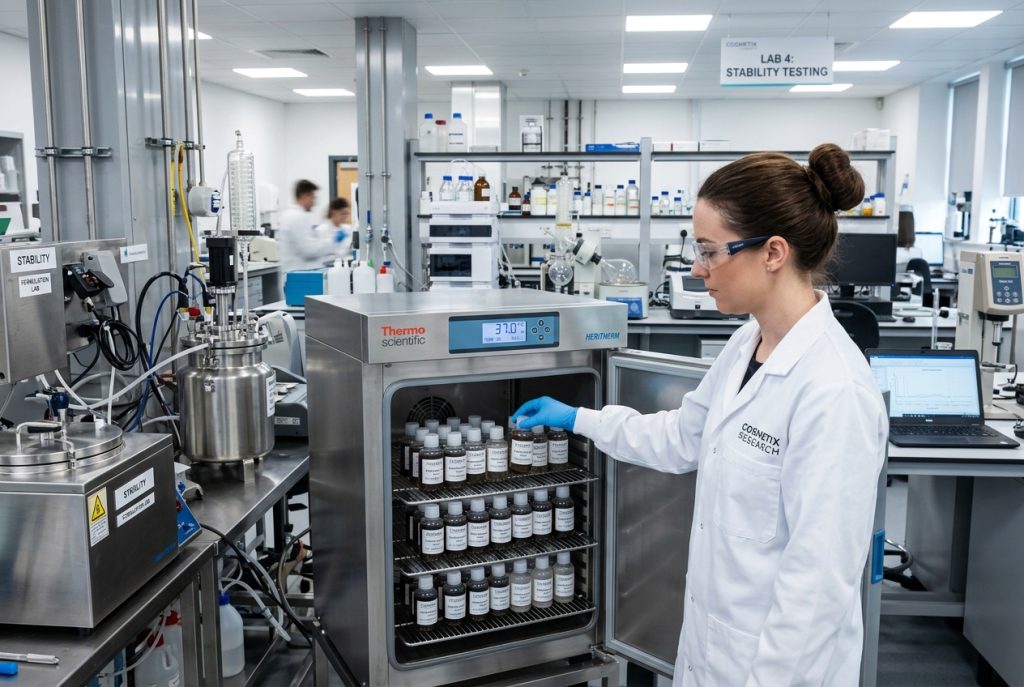
Stability testing is a mandatory step that simulates how your shampoo and conditioner formulas behave over time. By placing sample bottles in heat incubators and running freeze-thaw cycles, a hair care manufacturer can check that the formula does not separate, change color, grow mold, or leak. This lab testing ensures a reliable three-year shelf life. It is also required if you want to pass customs, satisfy FDA safety rules, and sell products in international retail markets.
Why stability testing is critical for hair care brands
When you launch a private label shampoo line, you usually spend your energy choosing fragrance oils and designing labels. But after your inventory leaves the factory, it faces the real world. Your boxes might sit in a hot shipping container for weeks, freeze in a delivery truck during winter, or stand in a humid bathroom for a year.
If your formula is not stable, these weather changes will destroy it. A high-quality conditioner can separate into water and a thick wax. A sulfate-free shampoo might turn yellow or grow black mold spots. If customers open a bad bottle, your brand will suffer from bad reviews and expensive product returns.
There are also strict laws about product safety. In the United States, the Modernization of Cosmetics Regulation Act (MoCRA) requires brands to keep records of safety data. In Europe, you must submit a Cosmetic Product Safety Report (CPSR) before you can sell anything. If you want to sell on Amazon, their warehouses have strict expiration policies. Skipping stability testing is a risk that can lead to customs rejections or legal trouble.
What is cosmetic stability testing?
Cosmetic stability testing is a scientific evaluation that proves a product remains safe and functional throughout its shelf life. A chemist monitors the physical, chemical, and biological traits of the shampoo or conditioner under stress. We want to ensure the product performs the same way from the day we fill it to the day the consumer empties it.
The laboratory team evaluates three areas of product quality:
First, we check physical quality. This includes viscosity, color, scent, and texture. The product must look and smell right.
Second, we check chemical quality. The pH level must remain steady. Active ingredients like salicylic acid for dandruff or rosemary oil for hair loss must not break down.
Third, we check biological quality. The preservatives in the bottle must remain strong enough to stop bacteria and mold from growing.
The science of emulsion stability in conditioners
Shampoos use surfactants to form simple micelles, which are relatively easy to keep stable. Hair conditioners are much more difficult. A hair conditioner is an emulsion, which means it is a mixture of water, oils, silicones, and fatty alcohols that do not naturally mix.
To keep the ingredients combined, chemists add emulsifiers. These agents create a protective barrier around the microscopic oil droplets, keeping them suspended in the water. However, heat makes these droplets move faster. If the temperature gets too high, the droplets collide with enough force to break the barrier. They fuse together, causing the conditioner to separate into layers of oil and water.

To prevent this, our laboratory chemists examine conditioner samples under high-power microscopes. We measure the size of the oil droplets. If the droplets are small and uniform, the mixture is stable. If the droplet sizes vary widely, the emulsion is weak. This microscopic check helps us adjust the formula before we start mass production.
Accelerated stability testing protocols
A real stability test would require storing a bottle at room temperature for three full years. To help brands launch products on time, laboratories use accelerated stability testing instead. Chemical reactions happen faster at higher temperatures. By placing test bottles in heat chambers, we can simulate years of storage in just twelve weeks.
Our standard testing program runs for twelve weeks. Storing a shampoo bottle at 45 degrees Celsius for twelve weeks simulates three years at room temperature. We divide the samples into four test groups:
First, we place samples in heat incubator ovens set to 37 degrees Celsius and 45 degrees Celsius. These chambers represent hot summer shipping and warehouse storage. Our chemists test the viscosity and pH levels of these samples every two weeks.
Second, we keep a control group at room temperature, which is 20 to 25 degrees Celsius. We store these samples in a dark cabinet to use as a baseline comparison.
Third, we put samples in a low temperature refrigerator set to 4 degrees Celsius. This cold test shows if the active ingredients will crystalize or if the shampoo will turn cloudy in cold weather.
Fourth, we run freeze-thaw cycles to stress the emulsion. We freeze the bottle at minus 10 degrees Celsius for 24 hours, then warm it to 40 degrees Celsius for 24 hours. We repeat this cycle five times. If the conditioner survives these temperature shifts without separating, it is ready for global distribution.
Microbiological safety and challenge testing
A stable shampoo must also resist bacteria. Users often keep shampoo bottles in warm, wet bathrooms, and they expose the liquid to air every time they press a pump. If the preservatives are weak, the shampoo will quickly spoil.
To verify the safety of custom formulations, our team performs a Preservative Efficacy Test, which is also called a challenge test. We add high concentrations of standard bacteria and mold to the formula. These include common microbes like Pseudomonas, E. coli, and Aspergillus mold.
We follow the ISO 11930 standards to measure the microbe levels at Day 7, Day 14, and Day 28. A reliable preservative system must reduce the bacteria by 99.9% within two weeks and prevent mold from growing. If the microbe counts remain low, the formula is safe for production.
Packaging compatibility and integrity testing
A stable formula is useless if the packaging fails. For this reason, we always test the formula inside the final bottle and cap. We must ensure the plastic container does not react with the shampoo ingredients.

During the twelve-week test, our chemists look for four common packaging issues:
First, we check for weight loss. If the cap seal is loose, water will evaporate from the formula. We weigh the bottles weekly. If a bottle loses more than 1.0% of its weight, the seal is weak.
Second, we check for chemical stress cracking. Active ingredients can cause PET or PP plastic bottles to crack around the neck threads. We inspect these areas under a magnifying glass.
Third, we check for discoloration. We expose clear bottles to light. If the shampoo turns yellow or the label artwork fades, we must choose opaque bottles or add UV absorbers to the formula.
Fourth, we check for pump corrosion. The metal springs inside pump caps can rust if they react with acidic formulas. We take the pumps apart to inspect the metal.
Stability testing methods and timelines
This table outlines the standard testing parameters used by cosmetic chemists to certify hair care stability.
| Testing Type | Testing Condition | Duration | Target Goal |
|---|---|---|---|
| Room Temp Control | 20°C – 25°C, dark environment | 12 Weeks | Baseline comparison for physical attributes |
| Oven Incubation | 37°C and 45°C chambers | 12 Weeks | Simulates 3-year shelf life under thermal stress |
| Cold Storage | 4°C chamber | 12 Weeks | Checks for crystallization, turbidity, and freezing |
| Freeze-Thaw Cycle | -10°C (24h) to 40°C (24h) | 5 Cycles | Evaluates emulsion resilience during transport |
| Centrifuge Test | 3,000 RPM at room temp | 30 Minutes | Forces quick detection of water-oil separation |
| Challenge Test | Inoculation with standard bacteria/mold | 28 Days | Validates preservative system effectiveness |
| Weight Loss Test | 45°C incubator with sealed bottles | 12 Weeks | Checks for water evaporation and seal integrity |
How SEVICH guarantees a 3-year shelf life
At SEVICH, quality control is the foundation of our business. Our 10,000 square meter factory operates under GMPC and ISO 22716 standards. We manage the entire stability testing process in our own laboratory.
We keep a library of over 3,000 pre-tested formulas. These formulations have already completed the full twelve-week stability program. If you choose our turnkey options, your shampoo is ready for production and export.
If you request a custom formulation, our chemists will prepare samples in five working days. We run accelerated incubator checks and centrifuge scans to guarantee safety. During production, our three-step quality check (raw materials, production line, finished packaging) ensures that every bottle matches the approved sample. You will receive certified documentation, including MSDS and COA sheets, to make customs clearance simple.
Request our turnkey private label guide
Ready to launch your custom shampoo and conditioner line? Contact our team today to get our turnkey catalog, wholesale pricing, and agent policies.
Frequently asked questions
What is the typical shelf life of private label shampoo?
The standard shelf life for unopened private label shampoo is three years. Once opened, the shelf life is typically 12 to 18 months, which is usually marked on the bottle using a Period After Opening (PAO) jar symbol.
Why does hair conditioner separate over time?
Conditioners are emulsions of oil and water. They separate if the emulsifying agents are not balanced, or if the product is exposed to extreme temperatures. Heat increases the kinetic energy of the formula, breaking the protective barrier around the oil droplets and causing them to group together.
Do I need to pay for stability testing if I use a manufacturer’s stock formula?
No. At SEVICH, our 3,000 stock formulas have already completed the full 12-week accelerated stability and compatibility testing program. You only need to perform new stability checks if you request custom active ingredients or supply your own custom bottles.
How do factories test if a shampoo will leak during air transit?
We place filled and capped bottles inside a vacuum chamber to simulate the low pressure of an aircraft cargo hold. We also run torque tests on capping lines and perform weight loss testing in high-temperature incubators to verify the seal integrity.
What is a freeze-thaw cycle test in cosmetics?
A freeze-thaw cycle test involves freezing the cosmetic sample at minus 10 degrees Celsius for 24 hours, then transferring it to a warm chamber at 40 degrees Celsius for another 24 hours. Running this cycle 5 times simulates extreme shipping climates and tests the resilience of the emulsion structure.
Does SEVICH provide regulatory documents for custom formulations?
Yes. We provide a full package of safety documents, including Material Safety Data Sheets (MSDS), Certificates of Analysis (COA) for every production batch, and formulation specifications required for FDA MoCRA and EU CPNP registrations.