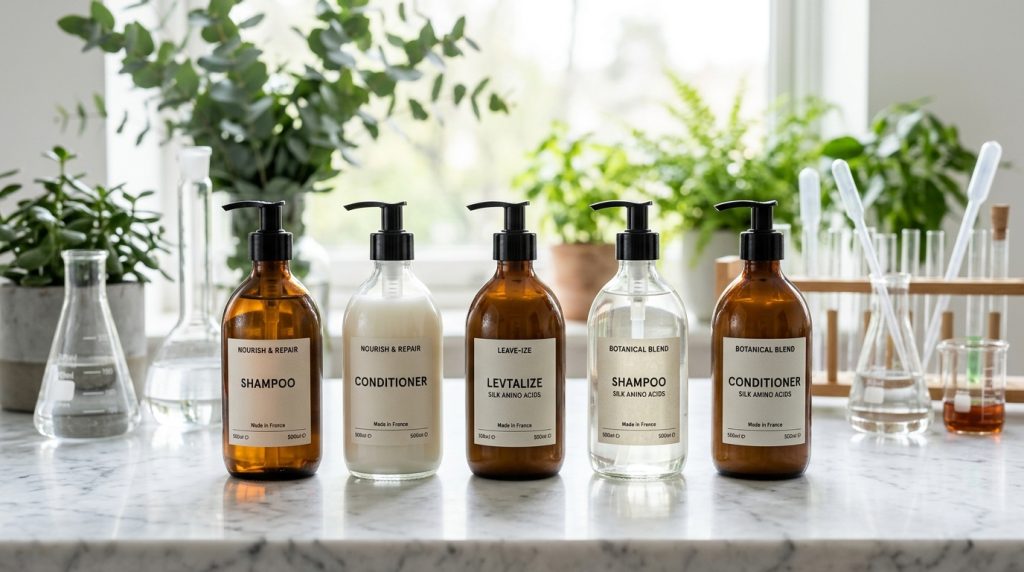
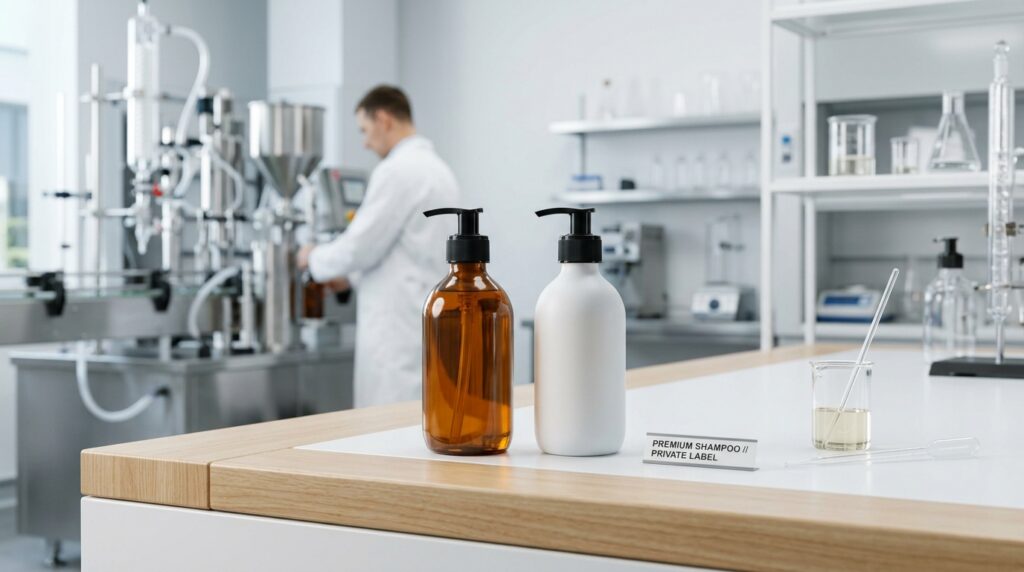
When choosing or developing hair care products, brand owners often ask: what is the difference between leave-in conditioner and regular conditioner? Both products add moisture to hair, but their chemistry, cationic surfactant levels, viscosity, and application methods differ completely. Start by comparing how each formula affects the hair cuticle, then evaluate how offering both products in your brand lineup can increase your customer retention and order values.

Short answer: Regular conditioner is a rinse-off emulsion engineered to smooth the hair cuticle right after shampooing. Leave-in conditioner is a lightweight, water-soluble stay-on treatment that remains on hair strands all day to protect against heat styling, UV rays, and environmental dryness.
Why understanding leave-in vs. regular conditioner matters for hair care brands
Conditioners might look similar in packaging, but in formulation and hair biology, they serve distinct roles. A regular rinse-out conditioner restores hydration and seals cuticles immediately after shampooing. A leave-in conditioner acts as an ongoing daily protective shield.
For a wider view of available manufacturing models, see our guide to conditioner OEM vs. ODM vs. private label or learn how to choose a hair conditioner OEM manufacturer.
Quick comparison: leave-in vs. regular conditioner
Regular conditioner relies on heavy cationic surfactants and fatty alcohols to smooth the hair cuticle after washing, requiring thorough rinsing after 2 to 5 minutes. Leave-in conditioner uses lightweight, water-soluble conditioning agents and micro cationic polymers that stay on clean, damp hair without weighing strands down.
| Technical Parameter | Regular (Rinse-Out) Conditioner | Leave-In Conditioner |
|---|---|---|
| Primary Function | Cuticle sealing and post-shampoo detangling | Continuous moisture barrier and heat protection |
| Surfactant Concentration | Higher cationic surfactants (1.5% to 4.0%) | Micro cationic polymers (< 1.0%) |
| Texture and Viscosity | Cream or thick emulsion (5,000 to 20,000 cPs) | Lightweight lotion or spray (100 to 3,000 cPs) |
| Rinse Required? | Yes (Rinse after 2 to 5 minutes) | No (Stays on clean, towel-dried hair) |
| Key Active Ingredients | Heavy silicones, shea butter, cetearyl alcohol | Hydrolyzed wheat protein, aloe vera, panthenol |
| Target Application | Mid-lengths to ends (avoid scalp) | Towel-dried hair ends and damp strands |
| Average Retail Margin | 50% to 65% | 55% to 75% |
1. What is regular (rinse-out) conditioner?
Shampoo opens the hair cuticle to clear away oil and dirt. Regular conditioner balances hair pH by coating open cuticles with positively charged cationic molecules, smoothing down the outer layer of the hair shaft.
How regular conditioners are formulated
Regular conditioners rely on a rich emulsion base built with fatty alcohols like cetearyl alcohol or cetyl alcohol. Chemists add strong cationic emulsifiers such as behentrimonium chloride or stearalkonium chloride. These agents attach to negatively charged hair strands, reducing wet-combing friction and sealing cuticle gaps.
Why rinse-out conditioner must be washed off
Leaving a standard rinse-out conditioner in hair causes three specific problems:
- Cationic surfactants irritate scalp tissue when left unwashed.
- Heavy fatty alcohols weigh down fine hair, making strands look limp and greasy.
- Trapped moisture beneath dense silicone layers can weaken the hair shaft over time.
2. What is leave-in conditioner?
Leave-in conditioner is a lightweight formula applied to damp, towel-dried hair. It stays on all day to detangle strands and keep hair hydrated.
How leave-in conditioners are formulated
Formulators use water-soluble humectants such as glycerin, panthenol (pro-vitamin B5), and sodium PCA to draw moisture into hair fibers. Hydrolyzed proteins like keratin or silk amino acids strengthen damaged strands, while light plant oils like argan or jojoba nourish ends without leaving greasy marks. The formula also creates a thermal shield that protects hair when blow-drying or flat-ironing.
Authoritative Safety Reference: Stay-on cosmetic ingredients must comply with safety limits established by the Cosmetic Ingredient Review (CIR) Expert Panel and FDA MoCRA Guidelines.
3. R&D and formulation science: how manufacturers craft both products
Creating a leave-in spray requires a completely different base than a heavy rinse-out cream. The project moves from cleanroom blending to viscosity testing and stability verification.
1. Viscosity control
Rinse-out conditioners use high-viscosity emulsification systems (8,000 to 18,000 cPs) designed for squeeze tubes, pump bottles, or wide-mouth jars. Leave-in conditioners use low-viscosity liquid or spray-lotion systems (100 to 2,500 cPs) that flow smoothly through fine-mist spray pumps.
2. Preservative system safety
Because leave-in products stay on skin and hair all day, the preservative blend must be mild and non-irritating. Chemists select broad-spectrum preservatives like phenoxyethanol and ethylhexylglycerin that meet global EU CPNP and US FDA compliance standards.
Authoritative Compliance Reference: SEVICH production facilities follow ISO 22716 Good Manufacturing Practices, conducting 3-step stability testing inside 45°C incubator chambers.
4. Private label opportunities: why brands need both in their lineup
Hair care brands and salon chains usually sell both types of conditioner together to increase average order value and customer retention.
Commercial advantages of a 2-step conditioning system
Offering a complete conditioning lineup provides three key advantages:
- Product bundling: Sell regular conditioner as the daily wash step and leave-in conditioner as the post-wash styling step.
- Higher repeat purchases: Customers reapply leave-in sprays daily between washes, using up bottles faster.
- Better OEM profit margins: Leave-in sprays cost less to package and command solid retail prices, yielding 60% to 75% gross margins.
SEVICH private label and OEM sourcing options
We offer three manufacturing paths based on your order size:
| Service Option | Minimum Order Quantity (MOQ) | Lead Time | Ideal Business Model |
|---|---|---|---|
| SEVICH Brand Distribution | 100 units ($150 USD) | 1 to 3 business days | E-commerce sellers, salon retail counters |
| Custom Private Label OEM | 2,000 to 3,000 units | 25 business days | Hair care brands, cosmetic importers |
| Bespoke Formula ODM | 5,000+ units | 30 business days | Unique botanical scents, custom bottle molds |
How SEVICH handles a custom conditioner project
SEVICH can start from a mature formula, an adjustment to a SEVICH base, a reference sample, or a custom formula specification. After the formulation path is clear, our R&D team confirms fill volume, container material, closure style, label finishing, and box design before preparing samples.
When the buyer approves the formula and packaging, the order enters commercial production under our GMPC system. Quality checkpoints cover incoming packaging inspection, production-line monitoring, and finished-goods release testing. Samples are delivered in 5 business days, and bulk orders ship in 25 business days upon final approvals.
SEVICH operates a 10,000 m² facility with 300 production workers and 20 automated lines, exporting over $15M annually across 600 global brand partners.
Request a custom conditioner sample kit and review
Send SEVICH your target product format, hair type focus, formula direction (e.g., Argan oil, Sulfate-free, Vegan), fragrance target, fill size, packaging ideas, target sales country, and quantity per SKU.
Our project team will review suitable formula options, planning MOQs, sample lead time, and bulk production terms. If you are a distributor, salon owner, or e-commerce retailer, you can also request details on SEVICH’s brand agent program.
Frequently asked questions
What is the main difference between leave-in and regular conditioner?
Rinse-out conditioners are thick emulsions designed to smooth cuticles after shampooing and be washed away. Leave-in conditioners are light, water-soluble products that stay on damp hair to protect strands throughout the day.
Can you use regular conditioner as a leave-in conditioner?
No. Regular conditioners contain heavy cationic surfactants and fatty alcohols that require rinsing. Leaving them on your scalp causes product buildup, irritation, and limp hair.
Should you use both regular conditioner and leave-in conditioner?
Yes. Using both provides full protection, especially for dry, curly, bleached, or heat-styled hair. Use regular conditioner in the shower after shampooing, then apply leave-in conditioner to towel-dried ends.
What ingredients work best in a private label leave-in conditioner?
Effective leave-in conditioners rely on humectants like panthenol and glycerin, hydrolyzed proteins like keratin or silk, lightweight plant oils like argan or jojoba, and thermal protectants.
What is the MOQ for custom private label conditioner manufacturing at SEVICH?
Custom private label OEM orders start at 2,000 to 5,000 units depending on packaging and formula specs. Authorized SEVICH brand distribution orders start at 100 units ($150 USD).
Are SEVICH conditioner formulations cruelty-free and eco-friendly?
Yes. All SEVICH products are certified cruelty-free under the Leaping Bunny Programme by Cruelty Free International. We also offer formulas with 82% biodegradability and PCR recycled plastic packaging.